


Page 45 - DK Eyewitness Travel Guides - The World's Must-See Places
P. 45
GREAT BRITAIN 43
THE CANTERBURY TALES
Considered to be the first great English
poet, Geoffrey Chaucer (c. 1345-1400) is
<hie fly remembeN!d tor The C anterbury ATlAtiTIC
Tales, a boisterous and Witty saga about OCEAN
a group of pilgrims who travel trom NORTH
SEA
London to Becket's shrine. The pilgrims GREAT
represent a cross-section ot 14th-century IRUANI> BRITAIN
English society and the tales are one ot
the most entertaining works _,. B irmingham •
of early E nglish literature. t.oOO~
Wife of Bath CANTERBURY
The Canterbury Tales CA THEOl!Al
ST. THOMAS BECKET
ST. AUGUSTINE When Archbishop Theobol d died in 1161,
King Henry II saw the opportunity to increase
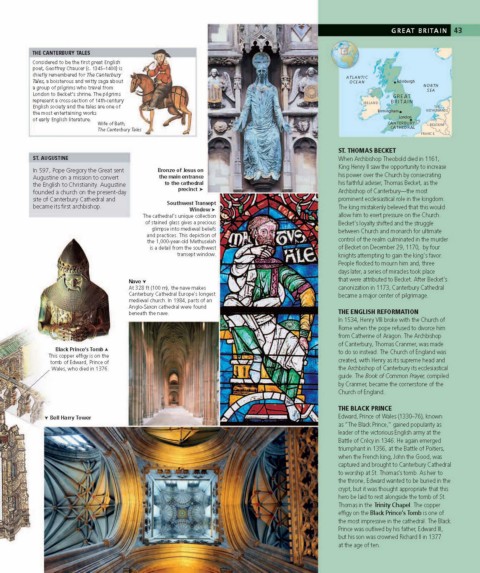
In 597, Pope Gregory the Great sent Bronze of Jesus on
Augustine on a mission to convert the main entrance his power over the Church by consecra ting
the Englis h to Christianity. Augustine to the cathedral his faithful adviser, Thomas Becket, as the
precinct>-
founded a church on the present-day Archbishop of Canterbury-the most
s ite of Canterbury Cathedral and Southwest Transept prominent ecclesiastical role in the kingdom.
became its first archbis hop. The king mistakenly believed that this would
Window>-
The cathedral's unique collection allow him to exert press ure on the Church.
of stained glass gives a precious Becket's I oyalty shifted and the struggle
glimpse into medi eva I beliefs between Church and monarch for ultimate
and practices. This depiction of
the 1 ,000-year-old Methuselah control of the realm culminated in the murder
is a detail from the southwest of Becket on December 29, 1170, by four
transept windcm. knights attempting to gain the king' s favor.
Pecple flocked to mourn him and, three
days later, a series of miracles took place
that were attributed to Becket. After Becket's
Nave Y
At 328ft (100 I'TV. the nave makes canonization in 1173, Canterbury Cathedral
Canterbury Cathedral E urope's longest became a m<4or center of pilgnmage
medieval church. In 1984, parts of an
Anglo-Saxon cathedral were found
beneath the na ve. THE ENGLISH REFORMATION
In 1534, Henry VIII broke with the Church of
Rome when the pope refused to divorce him
from Catherine of Aragon. The Archbis hop
of Canterbury, Thomas Cranmer, was made
Blade Prince's Tomb A
This copper effigy is on the to do so instead. The Church of England was
tomb of Edward. P rince of created, with Henry as its supreme head and
Wales , who died in 1376. the Archbishop of Canterbury its ecclesiastical
guide. The Book of Ccmmon Prayer, compiled
by Cranmer, became the cornerstone of the
Church of England.
,
THE BLACK PRINCE
Y Bell Harry Tower E dward, P rince of Wales (1330-76), known
as "The Black Prince," gained populanty as
leader of the victorious English army at the
Battle of Crecy in 1346. He again emerged
triumphant in 1356, at the Battle of Pdtiers,
when the French king, Jd1n the Good, was
captured and brought to Canterbury C athecr al
to worsllp at St. Thomas's tomb. As hetr to
the throne, Edward wanted to be buried in the
crypt, but it was thought appropnate that this
hero be I aid to rest alongside the tomb of St.
T homas in the Trinity Chapel. The copper
effigy on the Black Prince's Tomb is one of
the most impressive in the cathedral. The Black
Prince was outlived by his father, Edward Ill,
but his son was crowned Richard II in 1377
at the age of ten.

