


Page 76 - DK Eyewitness Travel Guides - The World's Must-See Places
P. 76
74  EUROPE                                     Heidelberg Castle


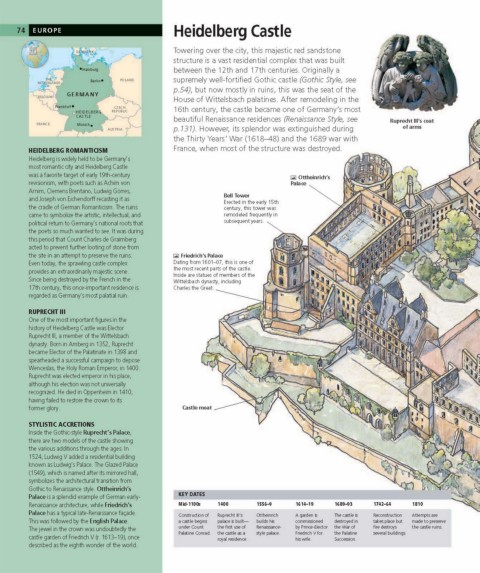
                                                     Towering over the city, this majestic red  sandstone
                                                     structure is  a vast residential complex that was built
                         •Hamburg                    between the 12th and  17th centuries. Originally a
              TH(. .:C               POlAND          supremely well-fortified Gothic castle (Gothic Style, see
            NlTHlRlANDS     Berlin•
          1?~:M      GERMANY                         p.54), but now mostly in  ruins, this was  the seat of the

                             'f!'                    House of Wittelsbach palatines. After remodeling in  the
                 F  nkfurt •
                      QHEIDELBE~,                    16th century, the castle became one of Germany's most
                       CASTLE
                                                     beautifu I Renaissance residences (Renaissance Style, see       Ruprecht Ill's coat
            FRANCE
                                                     p.131).  However,  its splendor was extinguished during             of arms
                                                     the Thirty Years' War (1618-48) and the 1689 war with
         HEIDELBERG ROMANTICISM                      France, when most of the structure was destroyed.
         Heidelberg is widely held to be Germany's
         most romantic city and Heidelberg Castle
         was a favorite target of early 19th-century
                                                                                        ~ Ottheinri<h's
         revisionism, with poets such as Achim von                                      Palace
         Arnim, Clemens Brentano, Ludwig Gorres,
                                                                    Bell Tower
         and Joseph von Eichendorff recasting it as
                                                                    Erected in the early 15th
         the cradle of German Romanticism. The ruins                century, this tower was
         came to symbolize the artistic, intellectual, and          remodeled  frequently in
                                                                    subsequent years.
         political return to Germany's national roots that
         the poets so much wanted to see. It was during
         this period that Count Charles de Graimberg
         acted to prevent further looting of stone from
         the site in an attempt to preserve the ruins.   ~ Friedri<h's Palace
         Even today, the sprawling castle complex    Dating from 1601-07, this is one of
                                                     the most recent parts of the castle.
         provides an extraordinarily majestic scene.
                                                     Inside are statues of members of the
         Since being destroyed by the French in the   Wittelsbach dynasty, including
          17th century, this once-important residence is   Charles the Great.
         regarded as Germany's most palatial ruin.

         RUPRECHT Ill
         One of the most important figures in the
         history of Heidelberg Castle was Elector
         Ruprecht Ill, a member of the Wittelsbach
         dynasty. Born in Amberg in 1352, Ruprecht
         became Elector of the Palatinate in 1398 and
         spearheaded a successful campaign to depose
         Wenceslas, the Holy Roman Emperor, in 1400.
         Ruprecht was elected emperor in his place,
         although his election was not universally
         recognized. He died in Oppenheim in 1410,
         having failed to restore the crown to its
         former glory.                                 Castle moat

         STYLISTIC ACCRETIONS
         Inside the Gothic-style Ruprecht's Palace,
         there are two models of the castle showing
         the various additions through the ages. In
          1524, Ludwig V added a residential building
         known as Ludwig's Palace. The Glazed Palace
         ( 1549), which is named after its mirrored hall,
         symbolizes the architectural transition from
         Gothic to Renaissance style. Ottheinrich's
                                                      KEY DATES
         Palace is a splendid example of German early-
         Renaissance architecture, while Friedrich's   Mid·1100s   1400      1556-9      1614-19     1689-93    1742-64     1810
         Palace has a typical late-Renaissance fa~ade
                                                      Constructbn of   Ruprecht Ill's   Ottheinrich   A garden is   lhe castle is   Reconstruction   Attempts are
          This was followed by the English Palace.    a castle begins   palace is built-  builds his   commissioned   destroyed in   takes place but   made to preserve
          The jewel in the crown was undoubtedly the   under Count   the first use of   Renaissance-  by Prince-Elector   the War of   fire destroys   the castle ruins.
                                                      Palatine Conrad.   the castle as a   style palace.   Friedrich V for   the Palatine   several buildings.
         castle garden of Friedrich V (r.  1613-19), once
                                                                  royal residence.       his wife.   Succession.
         described as the eighth wonder of the world.

