


Page 78 - DK Eyewitness Travel Guides - The World's Must-See Places
P. 78
76  EUROPE                                     Neuschwanstein Castle


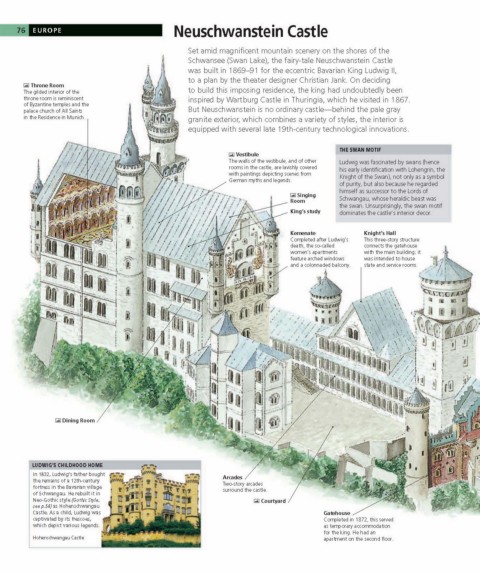
                                                         Set amid magnificent mountain scenery on the shores of the
                                                         Schwansee (Swan  Lake), the fairy-tale Neuschwanstein  Castle
                                                         was built in  1869-91  for the eccentric Bavarian  King  Ludwig II,
                                                         to a plan  by the theater designer Christian Jank.  On deciding
        ~Throne  Room
                                                         to build this imposing residence, the king had undoubtedly been
        The gilded interior of the
        throne room is reminiscent                       inspired  by Wartburg Castle in Thuringia, which he visited in  1867.
        of Byzantine temples and the
        palace church of All Saints                      But Neuschwanstein  is  no ordinary castle-behind the pale gray
        in  the Residence in Munich.                     granite exterior, which combines a variety of styles, the interior is
                                                         equipped with several late 19th-century technological innovations.

                                                                                                      THE SWAN MOTIF

                                                                                                      Ludwig was fascinated by swans (hence
                                                                                                      his early identification with Lohengrin, the
                                                                                                      Knight of the Swan), not only as a symbol
                                                                                                      of purity, but also because he regarded
                                                                                                      himself as successor to the Lords of
                                                                                                      Schwangau, whose heraldic beast was
                                                                                                      the swan. Unsurprisingly, the swan motif
                                                                                                      dominates the castle's interior decor.


                                                                                        Kemenate              Knight's Hall
                                                                                       Completed after Ludwig's   This three-story structure
                                                                                        death, the so-called   connects the gatehouse
                                                                                       women's apartments    with the main building; it
                                                                                                             was intended to house
                                                                                                             state and service rooms.


                 ~ Dining  Room


          LUDWIG'S CHILDHOOD HOME
           In 1832, Ludwig's father bought                         Arcades
           the remains of a 12th-century
           fortress In the Bavarian village                        Two-story arcades
                                                                   surround the castle.
           ot Schwangau. He rebuilt it  in
           Nee-Gothic style (Gotlic Style,                                  ~Courtyard
           see p.54} as Hohenschwangau
           Castle. As a child, Ludwig was                                                        Gatehouse
           captivated by its frescoes,                                                           Completed in  1872. this served
           which depict various legends.                                                         as temporary accommodation
                                                                                                 for the king. He had an
           Hohenschwangau Castle                                                                 apartment on the second floor.

