


Page 292 - (DK Eyewitness) Travel Guide - Australia
P. 292
290 THE NOR THERN TERRIT OR Y
8 Uluru-Kata Tjuta National Park
The most instantly recognizable of all Australian symbols is
the huge, red monolith of Uluru (Ayers Rock). Rising high above
the flat desert landscape, Uluru is one of the world’s natural
wonders, along with the 36 rock domes of Kata Tjuta (The
Olgas) and their deep valleys and gorges. Both sights are in
Uluru-Kata Tjuta National Park, 463 km (288 miles) southwest of
Alice Springs, which was established in 1958 and was named as
a World Heritage site in 1987 (see pp30–31). The whole area is
sacred to Aboriginal people and, in 1985, the park was handed
back to its indigenous owners and its sights reassumed their The Maruku Gallery
traditional names. As Aboriginal land, it is leased back to the This Aboriginal-owned gallery
sells traditional and modern
Australian government and jointly managed with the local Aboriginal crafts.
Anangu people. Within the park is an excellent
cultural centre which details the Aboriginal lives and
traditions of the area. Yulara, 12 km (7 miles) from
Uluru, is the park’s growing tourist resort (see p293).
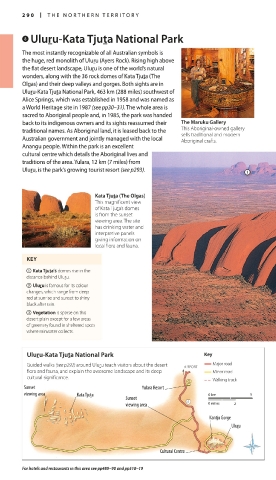
Kata Tjuta (The Olgas)
This magnificent view
of Kata Tjuta’s domes
is from the sunset
viewing area. The site
has drinking water and
interpretive panels
giving information on
local flora and fauna.
KEY
1 Kata Tjuta’s domes rise in the
distance behind Uluru.
2 Uluru is famous for its colour
changes, which range from deep
red at sunrise and sunset to shiny
black after rain.
3 Vegetation is sparse on this
desert plain except for a few areas
of greenery found in sheltered spots
where rainwater collects.
Uluru-Kata Tjuta National Park Key
Guided walks (see p292) around Uluru teach visitors about the desert AIRPORT Major road
flora and fauna, and explain the awesome landscape and its deep Minor road
cultural significance. Walking track
Sunset Yulara Resort
viewing area Kata Tjuta 0 km 5
Sunset
viewing area 0 miles 2
Kantju Gorge
Uluru
Cultural Centre
For hotels and restaurants in this area see pp489–90 and pp518–19

