


Page 294 - (DK Eyewitness) Travel Guide - Australia
P. 294
292 THE NOR THERN TERRIT OR Y
Exploring Uluru-Kata Tjuta National Park
It is impossible to arrive at Uluru-Kata Tjuta National Park and
not be filled with awe. The sheer size of the world’s largest
monolith, Uluru, rising from the flat desert plain, is a moving
and impressive sight. Just as magical are the rounded humps
of Kata Tjuta not far distant. All the rocks change colour from
oranges and reds to purple during the day. Getting around
the park, understanding some of its deep Aboriginal
significance and learning about its geology, flora and fauna
should not be rushed. There is much more to this fascinating
area than can be seen or experienced in one day, and a two-
or three-day stay is recommended.
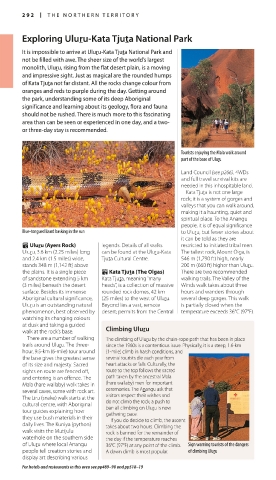
Tourists enjoying the Mala walk around
part of the base of Uluru
Land Council (see p266), 4WDs
and full travel survival kits are
needed in this inhospitable land.
Kata Tjuta is not one large
rock; it is a system of gorges and
valleys that you can walk around,
making it a haunting, quiet and
spiritual place. To the Anangu
people, it is of equal significance
Blue-tongued lizard basking in the sun to Uluru, but fewer stories about
it can be told as they are
} Uluru (Ayers Rock) legends. Details of all walks restricted to initiated tribal men.
Uluru, 3.6 km (2.25 miles) long can be found at the Uluru-Kata The tallest rock, Mount Olga, is
and 2.4 km (1.5 miles) wide, Tjuta Cultural Centre. 546 m (1,790 ft) high, nearly
stands 348 m (1,142 ft) above 200 m (660 ft) higher than Uluru.
the plains. It is a single piece } Kata Tjuta (The Olgas) There are two recommended
of sandstone extending 5 km Kata Tjuta, meaning “many walking trails. The Valley of the
(3 miles) beneath the desert heads”, is a collection of massive Winds walk takes about three
surface. Besides its immense rounded rock domes, 42 km hours and wanders through
Aboriginal cultural significance, (25 miles) to the west of Uluru. several deep gorges. This walk
Uluru is an outstanding natural Beyond lies a vast, remote is partially closed when the
phenomenon, best observed by desert; permits from the Central temperature exceeds 36°C (97°F).
watching its changing colours
at dusk and taking a guided
walk at the rock’s base. Climbing Uluru
There are a number of walking The climbing of Uluru by the chain-rope path that has been in place
trails around Uluru. The three- since the 1960s is a contentious issue. Physically, it is a steep, 1.6-km
hour, 9.5-km (6-mile) tour around (1-mile) climb in harsh conditions, and
the base gives the greatest sense several tourists die each year from
of its size and majesty. Sacred heart attacks or falls. Culturally, the
sights en route are fenced off, route to the top follows the sacred
and entering is an offence. The path taken by the ancestral Mala
Mala (hare wallaby) walk takes in (hare wallaby) men for important
several caves, some with rock art. ceremonies. The Anangu ask that
The Liru (snake) walk starts at the visitors respect their wishes and
cultural centre, with Aboriginal do not climb the rock; a push to
ban all climbing on Uluru is now
tour guides explaining how gathering pace.
they use bush materials in their If you do decide to climb, the ascent
daily lives. The Kuniya (python) takes about two hours. Climbing the
walk visits the Mutijulu rock is banned for the remainder of
waterhole on the southern side the day if the temperature reaches
of Uluru where local Anangu 36°C (97°F) at any point of the climb. Sign warning tourists of the dangers
people tell creation stories and A dawn climb is most popular. of climbing Uluru
display art describing various
For hotels and restaurants in this area see pp489–90 and pp518–19

