


Page 303 - (DK Eyewitness) Travel Guide - Australia
P. 303
INTRODUCING WESTERN A USTR ALIA 301
The Aborigines of the Kimberley
Legend suggests that the first Aborigines
arrived on the continent, near Broome,
200,000 years ago (see p51). While this is not
confirmed by scientific evidence (which
points more towards 55,000 years ago), the
fact that many of the “songlines” (see p35)
marked by landmarks and ceremonial sites
end or start around the Kimberley suggests
the area has long been inhabited by humans.
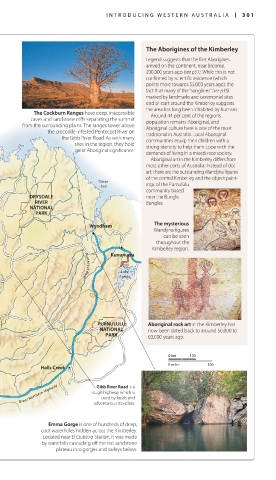
The Cockburn Ranges have deep, inaccessible Around 44 per cent of the region’s
caves and sandstone cliffs separating the summit population remains Aboriginal, and
from the surrounding plains. The ranges tower above Aboriginal culture here is one of the most
the crocodile-infested Pentecost River on traditional in Australia. Local Aboriginal
the Gibb River Road. As with many communities equip their children with a
sites in the region, they hold strong identity to help them cope with the
great Aboriginal significance. demands of living in a mixed-race society.
Aboriginal art in the Kimberley differs from
most other parts of Australia. Instead of dot
art, there are the outstanding Wandjina figures
of the central Kimberley and the object paint-
Timor ings of the Purnululu
Sea
community based
DRYSDALE near the Bungle
RIVER Bungles.
NATIONAL
PARK
Wyndham The mysterious
Wandjina figures
can be seen
throughout the
Kimberley region.
Kununurra
P
Pe
Lake
Ardyle
Pentecost River
PURNULULU Aboriginal rock art in the Kimberley has
NATIONAL now been dated back to around 50,000 to
PARK 60,000 years ago.
0 km 100
0 miles 100
Halls Creek
Great Northern Highway ay a rough highway which is
Gibb River Road is a
used by locals and
ea
e
adventurous travellers.
Emma Gorge is one of hundreds of deep,
cool waterholes hidden across the Kimberley.
Located near El Questro Station, it was made
by waterfalls cascading off the red sandstone
plateau into gorges and valleys below.

