


Page 298 - (DK Eyewitness) Travel Guide - Australia
P. 298
296 WESTERN A USTR ALIA
Western Australia at a Glance
The huge state of Western Australia encompasses a land mass of
more than 2,500,000 sq km (1,000,000 sq miles). In recent years,
the state’s popularity as a tourist destination has increased, with
large numbers of visitors drawn to its many areas of extreme
natural beauty. The landscape ranges from giant karri forests,
imposing mountains and meadows of wildflowers to vast
expanses of untamed wilderness with ancient gorges and rock
formations. The coastline has an abundance of beaches, ideal
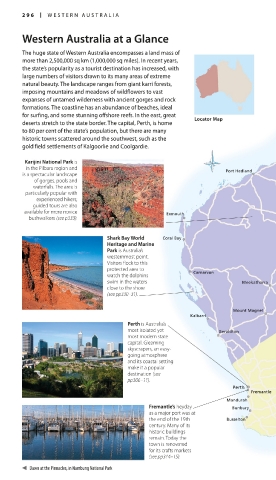
for surfing, and some stunning offshore reefs. In the east, great Locator Map
deserts stretch to the state border. The capital, Perth, is home
to 80 per cent of the state’s population, but there are many
historic towns scattered around the southwest, such as the
gold field settlements of Kalgoorlie and Coolgardie.
Karijini National Park is arijini National Park is arijini National Park
K K
in the Pilbara region and Port Hedland
is a spectacular landscape
of gorges, pools and
waterfalls. The area is
particularly popular with
experienced hikers;
guided tours are also
available for more novice Exmouth
bushwalkers (see p333).
Shark Bay World Coral Bay
Heritage and Marine
P P Park is Australia’s ark is Australia’s ark
westernmost point.
Visitors flock to this
protected area to Carnarvon
watch the dolphins
swim in the waters Meekatharra
close to the shore
(see pp330–31).
Mount Magnet
Kalbarri
Perth is Australia’s
most isolated yet Geraldton
most modern state
capital. Gleaming
skyscrapers, an easy-
going atmosphere
and its coastal setting
make it a popular
destination (see
pp306–11).
Perth
Fremantle
Mandurah
Fremantle’s heyday Bunbury
as a major port was at
the end of the 19th Busselton
century. Many of its
historic buildings
remain. Today the
town is renowned
for its crafts markets
(see pp314–15).
Dawn at the Pinnacles, in Nambung National Park

