


Page 460 - (DK Eyewitness) Travel Guide - Australia
P. 460
458 T ASM ANIA
Tasmania’s Wildlife and Wilderness
Tasmania’s landscape varies dramatically within its small area.
Parts of Tasmania are often compared to the green pastures
of England; however, the west of the state is wild and untamed.
Inland there are glacial mountains and wild rivers, the habitat of
flora and fauna unique to the island. More than 20 per cent of the
island is now designated as a World Heritage Area (see pp30–31). Russell Falls at Mount Field
National Park
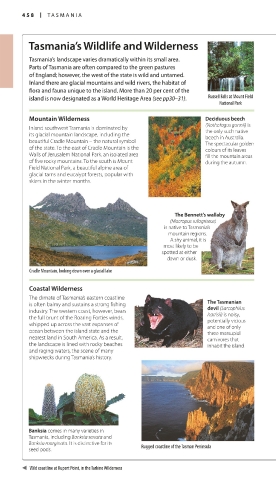
Mountain Wilderness Deciduous beech
(Nothofagus gunnii) is
Inland southwest Tasmania is dominated by the only such native
its glacial mountain landscape, including the beech in Australia.
beautiful Cradle Mountain – the natural symbol The spectacular golden
of the state. To the east of Cradle Mountain is the colours of its leaves
Walls of Jerusalem National Park, an isolated area fill the mountain areas
of five rocky mountains. To the south is Mount during the autumn.
Field National Park, a beautiful alpine area of
glacial tarns and eucalypt forests, popular with
skiers in the winter months.
The Bennett’s wallaby
(Macropus rufogriseus)
is native to Tasmania’s
mountain regions.
A shy animal, it is
most likely to be
spotted at either
dawn or dusk.
Cradle Mountain, looking down over a glacial lake
Coastal Wilderness
The climate of Tasmania’s eastern coastline
is often balmy and sustains a strong fishing The Tasmanian
industry. The western coast, however, bears devil (Sarcophilus
harrisii) is noisy,
the full brunt of the Roaring Forties winds, potentially vicious
whipped up across the vast expanses of and one of only
ocean between the island state and the three marsupial
nearest land in South America. As a result, carnivores that
the landscape is lined with rocky beaches inhabit the island.
and raging waters, the scene of many
shipwrecks during Tasmania’s history.
Banksia comes in many varieties in
Tasmania, including Banksia serrata and
Banksia marginata. It is distinctive for its Rugged coastline of the Tasman Peninsula
seed pods.
Wild coastline at Rupert Point, in the Tarkine Wilderness

