


Page 461 - (DK Eyewitness) Travel Guide - Australia
P. 461
INTRODUCING T ASM ANIA 459
River Wilderness
The southwest of Tasmania is
well known for its wild rivers,
particularly among avid whitewater
rafters. The greatest wild river is
the 120-km (75-mile) Franklin River,
protected within Franklin-Gordon
Wild Rivers National Park by its
World Heritage status. This is the
only undammed wild river left in
Australia, and despite its some-
times calm moments it often rages
fiercely through gorges, rainforests
and heathland.
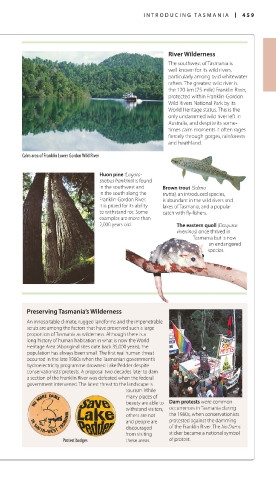
Calm area of Franklin Lower Gordon Wild River
Huon pine (Lagaro
strobus franklinii) is found
in the southwest and Brown trout (Salmo
in the south along the trutta), an intro duced species,
Franklin-Gordon River. is abundant in the wild rivers and
It is prized for its ability lakes of Tasmania, and a popular
to withstand rot. Some catch with fly-fishers.
examples are more than
2,000 years old. The eastern quoll (Dasyurus
viverrinus) once thrived in
Tasmania but is now
an endangered
species.
Preserving Tasmania’s Wilderness
An inhospitable climate, rugged landforms and the impenetrable
scrub are among the factors that have preserved such a large
proportion of Tasmania as wilderness. Although there is a
long history of human habitation in what is now the World
Heritage Area (Aboriginal sites date back 35,000 years), the
population has always been small. The first real human threat
occurred in the late 1960s when the Tasmanian government’s
hydroelectricity programme drowned Lake Pedder despite
conservationists’ protests. A proposal two decades later to dam
a section of the Franklin River was defeated when the federal
government intervened. The latest threat to the landscape is
tourism. While
many places of
beauty are able to Dam protests were common
withstand visitors, occurrences in Tasmania during
others are not the 1980s, when conservationists
and people are protested against the damming
discouraged of the Franklin River. The No Dams
from visiting sticker became a national symbol
Protest badges these areas. of protest.

