


Page 463 - (DK Eyewitness) Travel Guide - Australia
P. 463
T ASM ANIA 461
TASMANIA
Human habitation of Tasmania dates back 35,000
years, when Aborigines first reached the area. At this
time it was linked to continental Australia, but waters
rose to form the Bass Strait at the end of the Ice Age,
12,000 years ago. Dutch explorer Abel Tasman set foot on the
island in 1642 and inspired its modern name. He originally called
it Van Diemen’s Land, after the governor of the Dutch East Indies.
Belying its small size, Tasmania has a closed to visitors, but a few, such as
remarkably diverse landscape that the cliffs around Woolnorth, display
contains glacial mountains, dense forests this indigenous art for all to see.
and rolling green hills. Its wilderness is one The island’s early European history
of only three large temperate forests in the has also been well preserved in its many
southern hemisphere; it is also home to 19th-century buildings. The first real
many plants and animals unique to the settlement was at the waterfront site
island, including a ferocious marsupial, the of Hobart in 1804, now Tasmania’s
Tasmanian devil. Tasmanians are fiercely capital and Australia’s second-oldest
proud of their landscape and the island city. From here, European settlement
saw the rise of the world’s first Green spread throughout the state, with the
political party, the “Tasmanian Greens”. development of farms and villages,
One-fifth of Tasmania is protected as a built and worked by convict labour.
World Heritage Area (see pp30–31). Today, Tasmania is a haven for wildlife
The Tasmanian Aboriginal population lovers, hikers and fly-fishers, who come
was severely depleted with the arrival to experience the island’s many national
of Europeans in the 19th century; parks and forests. The towns scattered
however, around 20,000 people claim throughout the state, such as Richmond
Aboriginality in Tasmania today. Evidence and Launceston, with their rich colonial
of their link with the landscape has histories, are well worth a visit, and make
survived in numerous cave paintings. excellent bases from which to explore
Many Aboriginal sites remain sacred and the surrounding wilderness.
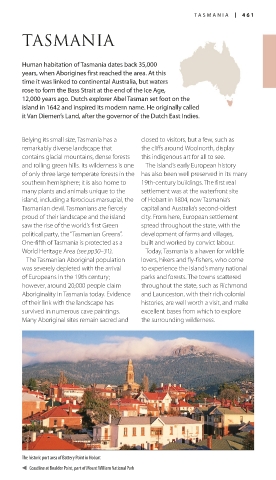
The historic port area of Battery Point in Hobart
Coastline at Boulder Point, part of Mount William National Park

