


Page 468 - (DK Eyewitness) Travel Guide - Australia
P. 468
466 T ASM ANIA
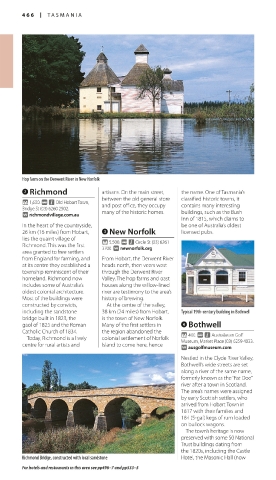
Hop farm on the Derwent River in New Norfolk
2Richmond artisans. On the main street, the name. One of Tasmania’s
between the old general store classified historic towns, it
* 1,600. @ n Old Hobart Town,
Bridge St (03) 6260 2502. and post office, they occupy contains many interesting
∑ richmondvillage.com.au many of the historic homes. buildings, such as the Bush
Inn of 1815, which claims to
In the heart of the countryside, be one of Australia’s oldest
26 km (16 miles) from Hobart, 3New Norfolk licensed pubs.
lies the quaint village of * 5,500. @ n Circle St (03) 6261
Richmond. This was the first 3700. ∑ newnorfolk.org
area granted to free settlers
from England for farming, and From Hobart, the Derwent River
at its centre they established a heads north, then veers west
township reminiscent of their through the Derwent River
homeland. Richmond now Valley. The hop farms and oast
includes some of Australia’s houses along the willow-lined
oldest colonial architecture. river are testimony to the area’s
Most of the buildings were history of brewing.
constructed by convicts, At the centre of the valley,
including the sandstone 38 km (24 miles) from Hobart, Typical 19th-century building in Bothwell
bridge built in 1823, the is the town of New Norfolk.
gaol of 1825 and the Roman Many of the first settlers in 4Bothwell
Catholic Church of 1834. the region abandoned the * 400. @ n Australasian Golf
Today, Richmond is a lively colonial settlement of Norfolk Museum, Market Place (03) 6259 4033.
centre for rural artists and Island to come here, hence
∑ ausgolfmuseum.com
Nestled in the Clyde River Valley,
Bothwell’s wide streets are set
along a river of the same name,
formerly known as the “Fat Doe”
river after a town in Scotland.
The area’s names were assigned
by early Scottish settlers, who
arrived from Hobart Town in
1817 with their families and
18-l (5-gal) kegs of rum loaded
on bullock wagons.
The town’s heritage is now
preserved with some 50 National
Trust buildings dating from
the 1820s, including the Castle
Richmond Bridge, constructed with local sandstone Hotel, the Masonic Hall (now
For hotels and restaurants in this area see pp496–7 and pp533–5

