


Page 476 - (DK Eyewitness) Travel Guide - Australia
P. 476
474 T ASM ANIA
d Port Arthur
Port Arthur was established in 1830 as a timber station
and a prison settlement for repeat offenders. While
transportation to the island colony from the mainland
ceased in 1853, the prison remained in operation until
1877, by which time some 12,000 men had passed
through what was commonly regarded as the harshest
institution of its kind in the British Empire. Punishments
included incarceration in the Separate Prison, a building
set apart from the main penitentiary, where inmates
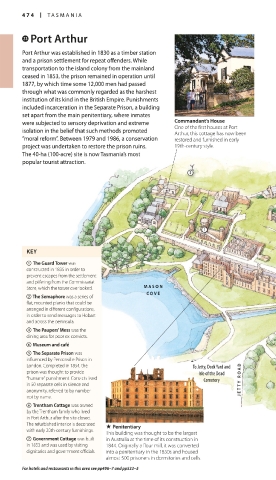
were subjected to sensory deprivation and extreme Commandant’s House
One of the first houses at Port
isolation in the belief that such methods promoted Arthur, this cottage has now been
“moral reform”. Between 1979 and 1986, a conservation restored and furnished in early
19th-century style.century style.
project was undertaken to restore the prison ruins. 19th-
The 40-ha (100-acre) site is now Tasmania’s most
popular tourist attraction.
KEY
1 The Guard Tower was
constructed in 1835 in order to
prevent escapes from the settlement
and pilfering from the Commissariat
Store, which the tower overlooked. M A S O N
C O V E
2 The Semaphore was a series of
flat, mounted planks that could be
arranged in different configurations,
in order to send messages to Hobart
and across the peninsula.
3 The Paupers’ Mess was the
dining area for poor ex-convicts.
4 Museum and café
5 The Separate Prison was
influenced by Pentonville Prison in
London. Completed in 1854, the To Jetty, Dock Yard and
prison was thought to provide Isle of the Dead
“humane” punishment. Convicts lived Cemetery J E T T Y R O A D
in 50 separate cells in silence and
anonymity, referred to by number
not by name.
6 Trentham Cottage was owned
by the Trentham family who lived
in Port Arthur after the site closed.
The refurbished interior is decorated . Penitentiary
with early 20th-century furnishings.
This building was thought to be the largest
7 Government Cottage was built in Australia at the time of its construction in
in 1853 and was used by visiting 1844. Originally a flour mill, it was converted
dignitaries and government officials. into a penitentiary in the 1850s and housed
almost 500 prisoners in dormitories and cells.
For hotels and restaurants in this area see pp496–7 and pp533–5

