


Page 53 - (DK Eyewitness) Travel Guide - Australia
P. 53
INTRODUCING A USTR ALIA 51
THE HISTORY
OF AUSTRALIA
Australia is a young nation in an ancient land. It is a nation of immigrants, past and
present, forced and free. The first European settlers occupied a harsh country; they
explored it, exploited its mineral wealth and farmed it. In so doing, they suffered at
the hands of nature, as well as enduring depressions and wars. Out of all this,
however, has emerged a modern and cosmopolitan society.
The first rocks of the Australian landscape simple chopping implements, roughly
began to form some four-and-a-half billion formed by grinding stone. By 8,000 BC
years ago. Over time many older rocks were Aborigines had developed the
covered by more recent rocks, but in places sophisticated returning boomerang (see
such as the Pilbara region of Western p34) and possibly the world’s first barbed
Australia erosion has exposed a landscape spear. So-called flaked tools of varying
3,500 million years old (see pp334–5). About styles were in use 5,000 years later, finely
500 million years ago Australia, together made out of grained stones such as flint
with South America, South Africa, India and to create sharp cutting edges.
the Antarctic, formed a supercontinent Beneath the apparently simple way of life,
known as Gondwanaland. This landmass Aboriginal society was complex. It was
moved through a series of different climatic based on a network of mainly nomadic
zones; today’s desert interior was once a bands, comprising between 50 and 100
shallow sea (see pp26–7). people, bound by kin relationships, who
lived according to strictly applied laws and
The First Immigrants customs. These laws and beliefs, including
Australia was first settled by Aboriginal the spiritual significance of the land, were
people who arrived by sea from Asia more upheld through a tradition of song, dance
than 60,000 years ago. On landing, they and art (see pp34–7). With no centralized or
quickly adapted to the climatic and formal system of government, individual
geographical conditions. Nomadic hunters groups were led by prominent, generally
and gatherers, the Aborigines moved with older men, who were held in great respect.
the seasons and spread across the Across the continent there were more than
continent, reaching Tasmania 35,000 years 200 languages spoken and approximately
ago. They had few material possessions 800 dialects. In many respects, Aboriginal
beyond the tools and weapons required for life was also very advanced: excavations at
hunting and obtaining food. The early tools, Lake Mungo provide fascinating evidence
known today as core tools, were very of ancient burial rituals, including what is
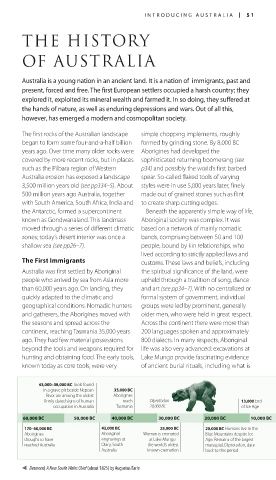
43,000–38,000 BC Tools found
in a grave pit beside Nepean 35,000 BC
River are among the oldest Aborigines
firmly dated signs of human reach Diprotodon 13,000 End
occupation in Australia Tasmania 20,000 BC of Ice Age
60,000 BC 50,000 BC 40,000 BC 30,000 BC 20,000 BC 10,000 BC
170–60,000 BC 42,000 BC 25,000 BC 20,000 BC Humans live in the
Aborigines Aboriginal Woman is cremated Blue Mountains despite Ice
thought to have engravings at at Lake Mungo – Age. Remains of the largest
reached Australia Olary, South the world’s oldest marsupial, Diprotodon, date
Australia known cremation back to this period
D D Desmond, A New South Wales Chief (about 1825) by Augustus Earleesmond, A New South Wales Chief (about 1825) by Augustus Earleesmond, A New South Wales Chief

