


Page 55 - (DK Eyewitness) Travel Guide - Australia
P. 55
THE HIST OR Y OF A USTR ALIA 53
to be rich in gold, when he sailed
along the Cape York Peninsula in
1606. He found the coast inhospitable.
In 1616 Dirk Hartog, commanding the
Eendracht, was blown off course on his
way to the East Indies. He landed on an
island off Western Australia and nailed
a pewter plate to a pole (see p330).
Dutch navigator Abel Tasman
charted large parts of Australia and
New Zealand between 1642 and
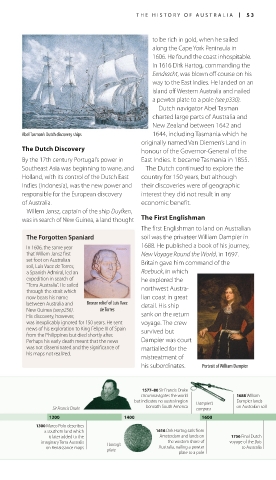
Abel Tasman’s Dutch discovery ships 1644, including Tasmania which he
originally named Van Diemen’s Land in
The Dutch Discovery honour of the Governor-General of the
By the 17th century Portugal’s power in East Indies. It became Tasmania in 1855.
Southeast Asia was beginning to wane, and The Dutch continued to explore the
Holland, with its control of the Dutch East country for 150 years, but although
Indies (Indonesia), was the new power and their discoveries were of geographic
responsible for the European discovery interest they did not result in any
of Australia. economic benefit.
Willem Jansz, captain of the ship Duyfken,
was in search of New Guinea, a land thought The First Englishman
The first Englishman to land on Australian
The Forgotten Spaniard soil was the privateer William Dampier in
In 1606, the same year 1688. He published a book of his journey,
that Willem Jansz first New Voyage Round the World, in 1697.
set foot on Australian Britain gave him command of the
soil, Luis Vaez de Torres,
a Spanish Admiral, led an Roebuck, in which
expedition in search of he explored the
“Terra Australia”. He sailed
through the strait which northwest Austra-
now bears his name lian coast in great
between Australia and Bronze relief of Luis Vaez detail. His ship
New Guinea (see p256). de Torres
His discovery, however, sank on the return
was inexplicably ignored for 150 years. He sent voyage. The crew
news of his exploration to King Felipe III of Spain survived but
from the Philippines but died shortly after.
Perhaps his early death meant that the news Dampier was court
was not disseminated and the significance of martialled for the
his maps not realized.
mistreatment of
his subordinates. Portrait of William Dampier
1577–80 Sir Francis Drake
circumnavigates the world 1688 William
but indicates no austral region Dampier’s Dampier lands
Sir Francis Drake beneath South America compass on Australian soil
1200 1400 1600
1300 Marco Polo describes
a southern land which 1616 Dirk Hartog sails from
is later added to the Amsterdam and lands on 1756 Final Dutch
imaginary Terra Australis Hartog’s the western shore of voyage of the Buis
on Renaissance maps plate Australia, nailing a pewter to Australia
plate to a pole

