


Page 54 - (DK Eyewitness) Travel Guide - Australia
P. 54
52 INTRODUCING A USTR ALIA
believed to be the world’s oldest works of the monk
cremation 25,000 years ago Beatus, showed the
(see p185). hypothetical land as
a populated region.
Theories of a Southern Land It was not until
In Europe, the existence of a the 15th century,
southern land was the subject when Europe entered a
of debate for centuries. As early golden age of exploration,
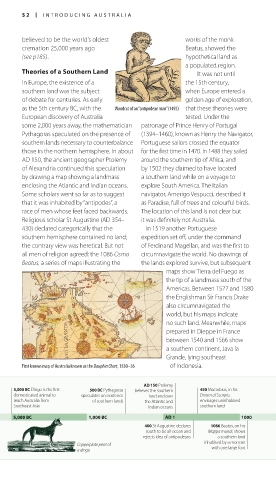
as the 5th century BC, with the Woodcut of an “antipodean man” (1493) that these theories were
European discovery of Australia tested. Under the
some 2,000 years away, the mathematician patronage of Prince Henry of Portugal
Pythagoras speculated on the presence of (1394–1460), known as Henry the Navigator,
southern lands necessary to counterbalance Portuguese sailors crossed the equator
those in the northern hemisphere. In about for the first time in 1470. In 1488 they sailed
AD 150, the ancient geographer Ptolemy around the southern tip of Africa, and
of Alexandria continued this speculation by 1502 they claimed to have located
by drawing a map showing a landmass a southern land while on a voyage to
enclosing the Atlantic and Indian oceans. explore South America. The Italian
Some scholars went so far as to suggest navigator, Amerigo Vespucci, described it
that it was inhabited by “antipodes”, a as Paradise, full of trees and colourful birds.
race of men whose feet faced backwards. The location of this land is not clear but
Religious scholar St Augustine (AD 354– it was definitely not Australia.
430) declared categorically that the In 1519 another Portuguese
southern hemisphere contained no land; expedition set off, under the command
the contrary view was heretical. But not of Ferdinand Magellan, and was the first to
all men of religion agreed: the 1086 Osma circumnavigate the world. No drawings of
Beatus, a series of maps illustrating the the lands explored survive, but subsequent
maps show Tierra del Fuego as
the tip of a landmass south of the
Americas. Between 1577 and 1580
the Englishman Sir Francis Drake
also circumnavigated the
world, but his maps indicate
no such land. Meanwhile, maps
prepared in Dieppe in France
between 1540 and 1566 show
a southern continent, Java la
Grande, lying southeast
First known map of Australia known as the Dauphin Chart, 1530–36Dauphin Chart, 1530–36Dauphin Chart of Indonesia.
AD 150 Ptolemy
5,000 BC Dingo is the first 500 BC Pythagoras believes the southern 450 Macrobius, in his
domesticated animal to speculates on existence land encloses Dream of Scorpio,
reach Australia from of southern lands the Atlantic and envisages uninhabited
Southeast Asia Indian oceans southern land
5,000 BC 1,000 BC AD 1 1000
400 St Augustine declares 1086 Beatus, on his
south to be all ocean and Mappa mundi, shows
rejects idea of antipodeans a southern land
Copperplate print of inhabited by a monster
a dingo with one large foot

