


Page 222 - Encyclopedia of Aquarium and Pond Fish, 3rd Edition
P. 222
220    MARINE FISH: MAINTENANCE

         Monitoring and adjusting


         Although the upkeep of a marine aquarium—especially a reef
         tank—is more demanding than a freshwater system,
         a few routine maintenance tasks and the judicious use of
         test kits to check water quality will ensure a healthy
         environment for the tank occupants. Watch for
         signs of algal overgrowth, and carefully observe
         the fish, since abnormal behavior may be an early
         indicator of deteriorating conditions.

         Algae are key ingredients of reef aquariums, but if they
         become rampant, they look unsightly and may
         smother corals, causing them to die. While you can
         physically remove the algal overgrowth, you should also address
         the underlying cause of the problem, which could be excessive
         or inadequate lighting, or high levels of nitrate and phosphate.
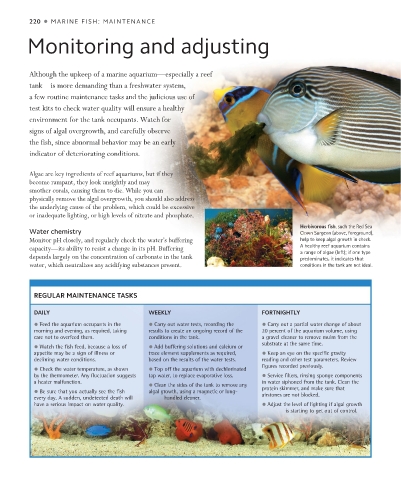
                                                                                    Herbivorous fish, such the Red Sea
         Water chemistry                                                            Clown Surgeon (above, foreground),
         Monitor pH closely, and regularly check the water’s buffering              help to keep algal growth in check.
         capacity—its ability to resist a change in its pH. Buffering               A healthy reef aquarium contains
         depends largely on the concentration of carbonate in the tank              a range of algae (left); if one type
                                                                                    predominates, it indicates that
         water, which neutralizes any acidifying substances present.                conditions in the tank are not ideal.


          REGULAR MAINTENANCE TASKS

          DAILY                           WEEKLY                         FORTNIGHTLY
          •  Feed the aquarium occupants in the   •  Carry out water tests, recording the   •  Carry out a partial water change of about
          morning and evening, as required, taking   results to create an ongoing record of the   20 percent of the aquarium volume, using
          care not to overfeed them.      conditions in the tank.        a gravel cleaner to remove mulm from the
          •  Watch the fish feed, because a loss of   •  Add buffering solutions and calcium or   substrate at the same time.
          appetite may be a sign of illness or   trace element supplements as required,   •  Keep an eye on the specific gravity
          declining water conditions.     based on the results of the water tests.  reading and other test parameters. Review
          •  Check the water temperature, as shown    •  Top off the aquarium with dechlorinated   figures recorded previously.
          by the thermometer. Any fluctuation suggests   tap water, to replace evaporative loss.  •  Service filters, rinsing sponge components
          a heater malfunction.           •  Clean the sides of the tank to remove any   in water siphoned from the tank. Clean the
          •  Be sure that you actually see the fish   algal growth, using a magnetic or long-  protein skimmer, and make sure that
          every day. A sudden, undetected death will   handled cleaner.  airstones are not blocked.
          have a serious impact on water quality.                        •  Adjust the level of lighting if algal growth
                                                                                is starting to get out of control.


   US_220-223_Testing_and_Monitoring.indd   220                                                      29/08/18   4:10 PM

