


Page 226 - Encyclopedia of Aquarium and Pond Fish, 3rd Edition
P. 226
224    MARINE FISH:   ILLNESS AND TREATMENT

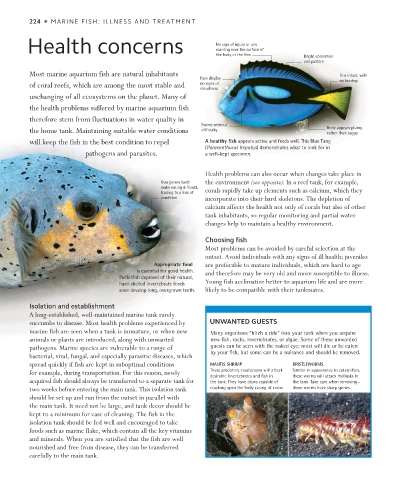
         Health concerns                                     No sign of injury or any
                                                             scarring over the surface of
                                                             the body or the fins    Bright coloration
                                                                                     and pattern
         Most marine aquarium fish are natural inhabitants                                     Fins intact, with
                                                        Eyes display                           no tearing
         of coral reefs, which are among the most stable and   no signs of
                                                        cloudiness
         unchanging of all ecosystems on the planet. Many of
         the health problems suffered by marine aquarium fish
         therefore stem from fluctuations in water quality in
                                                         Swims without
         the home tank. Maintaining suitable water conditions   difficulty                 Body appears plump,
                                                                                           rather than saggy
         will keep the fish in the best condition to repel   A healthy fish appears active and feeds well. This Blue Tang
                                                          (Paracanthurus hepatus) demonstrates what to look for in
                         pathogens and parasites.         a well-kept specimen.

                                                          Health problems can also occur when changes take place in
                                             Overgrown teeth   the environment (see opposite). In a reef tank, for example,
                                             make eating difficult,   corals rapidly take up elements such as calcium, which they
                                             leading to a loss of
                                             condition    incorporate into their hard skeletons. The depletion of
                                                          calcium affects the health not only of corals but also of other
                                                          tank inhabitants, so regular monitoring and partial water
                                                          changes help to maintain a healthy environment.
                                                          Choosing fish
                                                          Most problems can be avoided by careful selection at the
                                                          outset. Avoid individuals with any signs of ill health; juveniles
                                            Appropriate food   are preferable to mature individuals, which are hard to age
                                       is essential for good health.    and therefore may be very old and more susceptible to illness.
                                  Pufferfish deprived of their natural,
                                  hard-shelled invertebrate foods   Young fish acclimatize better to aquarium life and are more
                                  soon develop long, overgrown teeth.    likely to be compatible with their tankmates.

         Isolation and establishment
         A long-established, well-maintained marine tank rarely
         succumbs to disease. Most health problems experienced by   UNWANTED GUESTS
         marine fish are seen when a tank is immature, or when new   Many organisms “hitch a ride” into your tank when you acquire
         animals or plants are introduced, along with unwanted   new fish, rocks, invertebrates, or algae. Some of these unwanted
         pathogens. Marine species are vulnerable to a range of   guests can be seen with the naked eye; most will die or be eaten
         bacterial, viral, fungal, and especially parasitic diseases, which   by your fish, but some can be a nuisance and should be removed.
         spread quickly if fish are kept in suboptimal conditions—    MANTIS SHRIMP  BRISTLEWORMS
         for example, during transportation. For this reason, newly   These predatory crustaceans will attack   Similar in appearance to caterpillars,
                                                           desirable invertebrates and fish in
                                                                                  these worms will attack mollusks in
         acquired fish should always be transferred to a separate tank for   the tank. They have claws capable of   the tank. Take care when removing—
         two weeks before entering the main tank. This isolation tank   cracking open the body casing of crabs.  these worms have sharp spines.
         should be set up and run from the outset in parallel with
         the main tank. It need not be large, and tank decor should be
         kept to a minimum for ease of cleaning. The fish in the
         isolation tank should be fed well and encouraged to take
         foods such as marine flake, which contain all the key vitamins
         and minerals. When you are satisfied that the fish are well
         nourished and free from disease, they can be transferred
         carefully to the main tank.


   US_224-229_Illness_M.indd   224                                                                   29/08/18   4:10 PM

