


Page 218 - Encyclopedia of Aquarium and Pond Fish, 3rd Edition
P. 218
216    MARINE FISH: SETTING UP THE TANK

         The maturation process                           Stocking the tank
         Coral reefs are very stable environments, and the fish living   A vast range of colorful and interesting species are available
         there are not adapted to significant shifts in water parameters   today from aquarist suppliers, but it is important to take time
         such as temperature, salinity, or water chemistry. In the   to plan and research the numbers and species of fish that are
         aquarium, therefore, conditions need to be stabilized    appropriate for your particular setup before you make any
         before the tank can be stocked with more delicate fish and   purchases. A typical rectangular aquarium can support 1 in
         invertebrates. Before the biological filter is fully functional,   (2.5 cm) of fish per 4 gallons (15 liters) of water in the first
         levels of ammonia and nitrites can rise to dangerous levels    six months, increasing to 1 in (2.5 cm) of fish per 2 gallons
         (see p.222). One way to speed up the maturation process is to   (7.5 liters) thereafter. If you introduce very fast-growing
         introduce hardier species, such as damselfish (see pp.240–243),   species into the aquarium, however, their eventual size must
         into the new tank; these fish can endure the fluctuating water   be taken into account when calculating the stocking density,
         quality, and the waste they produce encourages populations    in order to avoid overstocking problems at a later date.
         of beneficial bacteria to develop within the biological filter.    Make sure the fish you choose are compatible with one
         In addition, cultures of beneficial bacteria are available that   another; if you are planning to create a reef tank, check that
         can be added to the tank. Regular testing (see pp.220–222) will   they will not harm invertebrates. Fish to be introduced should
         reveal when the water conditions have stabilized; at this point,   ideally first be quarantined in a separate tank for up to two
         ammonia and nitrite levels should be virtually undetectable.  weeks, to allow any signs of illness to become apparent.


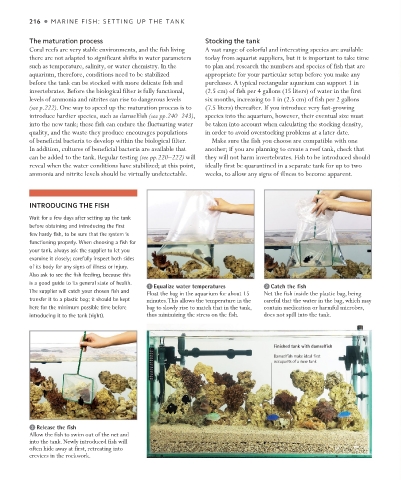
         INTRODUCING THE FISH
         Wait for a few days after setting up the tank
         before obtaining and introducing the first
         few hardy fish, to be sure that the system is
         functioning properly. When choosing a fish for
         your tank, always ask the supplier to let you
         examine it closely; carefully inspect both sides
         of its body for any signs of illness or injury.
         Also ask to see the fish feeding, because this
         is a good guide to its general state of health.    1  Equalize water temperatures   1  Catch the fish
                                          1
                                                                          2
         The supplier will catch your chosen fish and   Float the bag in the aquarium for about 15   Net the fish inside the plastic bag, being
         transfer it to a plastic bag; it should be kept   minutes. This allows the temperature in the   careful that the water in the bag, which may
         here for the minimum possible time before   bag to slowly rise to match that in the tank,   contain medication or harmful microbes,
         introducing it to the tank (right).  thus minimizing the stress on the fish.  does not spill into the tank.


                                                                             Finished tank with damselfish
                                                                             Damselfish make ideal first
                                                                             occupants of a new tank


          1  Release the fish
          3
         Allow the fish to swim out of the net and
         into the tank. Newly introduced fish will
         often hide away at first, retreating into
         crevices in the rockwork.


   US_216-217_Setting_up_the_tank2.indd   216                                                        29/08/18   4:10 PM

