


Page 310 - Encyclopedia of Aquarium and Pond Fish, 3rd Edition
P. 310
308    POND FISH: SETTING UP THE POND

         Plants and landscaping


         In addition to enhancing the look of a pond, plants help to maintain
         water quality, providing a healthy environment for the fish. The choice   TIPS FOR CHOOSING PLANTS
         of plants will partly depend on the style of pond—a naturalistic pond    •  Avoid buying plants in the winter when
         looks best when heavily planted around the edges so that it blends   they are dormant, because it is impossible
                                                                           to tell how healthy they are.
         seamlessly into its environment, while a contemporary look may be    •  Examine plants carefully for potential
         best achieved with more minimalist planting.                      pests, such as aquatic snails.
                                                                           •  Plants already set in containers will
                                                             Plant has     grow faster than bare-rooted plants,
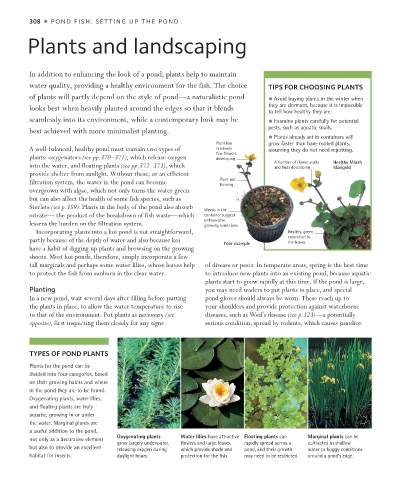
         A well-balanced, healthy pond must contain two types of   relatively   assuming they do not need repotting.
         plants: oxygenators (see pp.370–371), which release oxygen   few flowers
                                                             developing
         into the water, and floating plants (see pp.372–373), which         A number of flower stalks   Healthy Marsh
                                                                                             Marigold
                                                                             and buds developing
         provide shelter from sunlight. Without these, or an efficient
         filtration system, the water in the pond can become   Plant not
                                                              thriving
         overgrown with algae, which not only turns the water green
         but can also affect the health of some fish species, such as
         Sterlets (see p.359). Plants in the body of the pond also absorb   Weeds in the
         nitrate— the product of the breakdown of fish waste—which    container suggest
         lessens the burden on the filtration system.    unfavorable
                                                         growing conditions
           Incorporating plants into a koi pond is not straightforward,         Healthy, green
         partly because of the depth of water and also because koi    Poor example  coloration to
                                                                                the leaves
         have a habit of digging up plants and browsing on the growing
         shoots. Most koi ponds, therefore, simply incorporate a few
         tall marginals and perhaps some water lilies, whose leaves help   of disease or pests. In temperate areas, spring is the best time
         to protect the fish from sunburn in the clear water.  to introduce new plants into an existing pond, because aquatic
                                                          plants start to grow rapidly at this time. If the pond is large,
         Planting                                         you may need waders to put plants in place, and special
         In a new pond, wait several days after filling before putting   pond gloves should always be worn. These reach up to
         the plants in place, to allow the water temperature to rise    your shoulders and provide protection against waterborne
         to that of the environment. Pot plants as necessary (see   diseases, such as Weil’s disease (see p.323)—a potentially
         opposite), first inspecting them closely for any signs    serious condition, spread by rodents, which causes jaundice.


         TYPES OF POND PLANTS
         Plants for the pond can be
         divided into four categories, based
         on their growing habits and where
         in the pond they are to be found.
         Oxygenating plants, water lilies,
         and floating plants are truly
         aquatic, growing in or under
         the water. Marginal plants are
         a useful addition to the pond,
         not only as a decorative element    Oxygenating plants    Water lilies have attractive   Floating plants can   Marginal plants can be
                                                                                      cultivated in shallow
                                 grow largely underwater,
                                                   flowers and large leaves,
                                                                    rapidly spread across a
         but also to provide an excellent   releasing oxygen during   which provide shade and   pond, and their growth   water or boggy conditions
         habitat for insects.    daylight hours.   protection for the fish.  may need to be restricted.  around a pond’s edge.


   US_308-309_Plants_Landscaping.indd   308                                                          29/08/18   4:11 PM

