


Page 314 - Encyclopedia of Aquarium and Pond Fish, 3rd Edition
P. 314
312    POND FISH: SETTING UP THE POND

         Coldwater fish in the home


         Many coldwater fish can be kept indoors in aquariums;
         indeed, some of the smaller, less colorful species are   SETTING UP A COLDWATER AQUARIUM
         more visible there than in a pond. Even larger species,   The setup of a coldwater tank is very similar to that of a freshwater
         such as koi and sterlets, may be housed in a tank when   tank (see pp.38–42), except that it lacks a heater and can support a
                                                           different range of plant species. Coldwater tanks benefit from a
         small, but they must be moved outdoors when they   simple filtration system, such as an undergravel or power filter
                                                           (see pp.34–35). Lighting is important; a light in the hood assists plant
         outgrow their surroundings. Some coldwater fish cannot   growth and enhances the visual impact of the fish. Pale-colored
         survive the winter in a pond, especially in temperate   gravel is the best choice for a goldfish tank, providing a striking
                                                           contrast to the fish’s vivid colors; avoid red or blue gravel, because
         areas, and must be housed indoors until spring.   it makes their coloration appear dull. Goldfish excavate the gravel
                                                           when searching for food, which can make it difficult to establish
                                                           plants. Protect the plants by securing them in place with rocks.
         It is no coincidence that, numerically, goldfish (see pp.332–343)
         rank as the most popular pets in the world. Their care,
         whether indoors in aquarium surroundings or outdoors in a
         pond, is very straightforward. Not only are goldfish unfussy in
         their water chemistry requirements, but they will also live
         happily in unheated, dechlorinated tap water. Goldfish are
         generally not nervous or shy, especially once established in
         an aquarium, and it is usually possible to keep two or more
         together without difficulty. Different varieties can successfully
         be kept together in a single tank, but it is best to avoid mixing
         fancy varieties with goldfish with simple fins and tails; these
         attractive fish were bred for their looks rather than their

                                                          swimming ability and may lose out to their more agile
                                                          relatives in the daily competition to find food.
                                                           Although less commonly kept, small minnows and other
                                                          similar-sized coldwater species will also thrive in planted
                                                          aquariums indoors. Others, however, notably members of the
                                                          sturgeon family, may not thrive at typical room temperature,
                                                          especially when young; this is because they stop feeding at
                                                          water temperatures of more than 68°F (20°C).
                                                          Seasonal accommodation
                                                          Some species of coldwater fish that are kept in a pond over the
                                                          summer months must be moved indoors for the duration of
                                                          the winter. This particularly applies to fancy goldfish varieties,
                                                           which are not hardy enough to overwinter in cold, possibly
                                                            freezing, water. Their corpulent body shape means that
                                                             they are especially vulnerable to swim bladder problems
                                                              linked with low water temperatures, which cause them
                                                              to float at an abnormal angle in the water. Set up an
                                                               aquarium in advance of the start of colder weather,

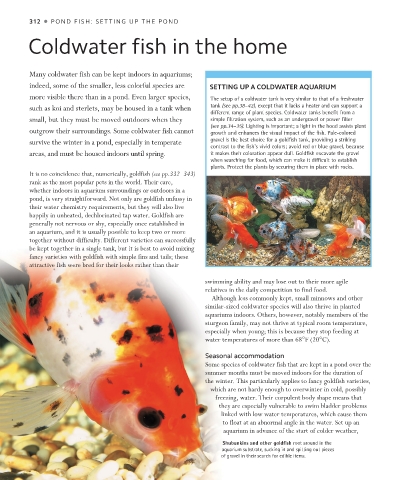
                                                              Shubunkins and other goldfish root around in the
                                                              aquarium substrate, sucking in and spitting out pieces
                                                              of gravel in their search for edible items.


   US_312-313_Coldwat_Fish_Maint_Ch.indd   312                                                       29/08/18   4:11 PM

