


Page 248 - The Rough Guide to Myanmar (Burma)
P. 248
246  INLE LAKE AND THE EAST PINDAYA
                                         understated charm. Arid for most of the
            PINDAYA                      year, the region explodes into a
                              N          patchwork of green after the rains,
                                         making this one of Shan State’s most
                                         important agricultural zones. In and
               Kantha Kyaung
                                         around town, you’ll probably see some
                   HIGHWAY 41            of the many Danu and Pa-O who live in
    6     to Taunggyi  Bus to Taunggyi   the area, resplendent underneath
            Minibus
                                         colourful headdresses.
           KBZ Bank            HIGHWAY 41
                       Pone
                     Taloke Lake
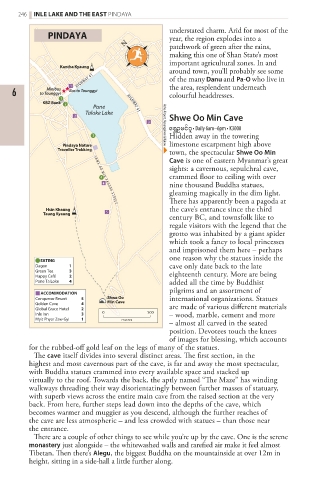
                                         Shwe Oo Min Cave
                                               • Daily 6am–6pm • K3000
                                         Hidden away in the towering
                Pindaya Nature           limestone escarpment high above
                                       Heho Airport, Nyaungshwe & Kalaw
               Traveller Trekking
                                         town, the spectacular Shwe Oo Min
                                         Cave is one of eastern Myanmar’s great
                                         sights: a cavernous, sepulchral cave,
                                         crammed floor to ceiling with over
                                         nine thousand Buddha statues,
                                         gleaming magically in the dim light.
                                         There has apparently been a pagoda at
                       S H W E   O O   M I N   P A G O D A   S T R E E T
            Hsin Khaung                  the cave’s entrance since the third
           Taung Kyaung
                                         century BC, and townsfolk like to
                                         regale visitors with the legend that the
                                         grotto was inhabited by a giant spider
                                         which took a fancy to local princesses
                                         and imprisoned them here – perhaps
                                         one reason why the statues inside the
          EATING
         Dagon   1                       cave only date back to the late
         Green Tea  3                    eighteenth century. More are being
         Happy Café  2
                                         added all the time by Buddhist
         Pone Ta Loke  4
                                         pilgrims and an assortment of
           ACCOMMODATION
         Conqueror Resort   5  Shwe Oo   international organizations. Statues
         Golden Cave  4   Min Cave       are made of various different materials
         Global Grace Hotel   2
         Inle Inn   3    0          500  – wood, marble, cement and more
         Myit Phyar Zaw Gyi   1  metres
                                         – almost all carved in the seated
                                         position. Devotees touch the knees
                                         of images for blessing, which accounts
        for the rubbed-off gold leaf on the legs of many of the statues.
         The cave itself divides into several distinct areas. The first section, in the
        highest and most cavernous part of the cave, is far and away the most spectacular,
        with Buddha statues crammed into every available space and stacked up
        virtually to the roof. Towards the back, the aptly named “The Maze” has winding
        walkways threading their way disorientatingly between further masses of statuary,
        with superb views across the entire main cave from the raised section at the very
        back. From here, further steps lead down into the depths of the cave, which
        becomes warmer and muggier as you descend, although the further reaches of
        the cave are less atmospheric – and less crowded with statues – than those near
        the entrance.
         There are a couple of other things to see while you’re up by the cave. One is the serene
        monastery just alongside – the whitewashed walls and rarefied air make it feel almost
        Tibetan. Then there’s Alegu, the biggest Buddha on the mountainside at over 12m in
        height, sitting in a side-hall a little further along.

