


Page 305 - The Rough Guide to Myanmar (Burma)
P. 305
INWA Mandalay and around  303
       The city was founded in 1313 by King Thihathu, youngest of the three brothers who
       had previously established the Myinsaing Kingdom (see p.361), perhaps the most
       significant of the various mini-states which emerged following the collapse of Bagan.
       From Pinya, Thihathu and his successors controlled a sizeable swathe of central
       Myanmar between 1313 and 1364, when the kingdom was merged with that of nearby
       Sagaing (see box, p.281).
        The small but modestly interesting sight sees few visitors but is an easy stop-off
       while travelling to or from the airport. Little remains of Thihathu’s former capital,
       once covering over a square kilometre, save a brooding trio of almost windowless
       Bagan-style temples (currently under restoration, although you can still visit), built
       of red brick and still preserving traces of old murals and glazed tiles decorated with
       Jataka scenes.

       Inwa
                                                                      7
       Now a sleepy rural village, INWA was once a place of great importance. Originally
       known as Ava, it served as the capital of Myanmar on four separate occasions, totalling
       over three hundred years (see box, p.281) – almost impossible to imagine today while
       you’re rumbling between fields along the dusty lanes.
        Scattered in and around the ancient city walls, sections of which remain visible (as do
       the ditches which once formed the surrounding moats), the various sights dating from
       Inwa’s regal era are quite spread out; the vast majority of visitors chalk them off as part
       of a horse-drawn carriage tour (see p.305). A pleasant alternative is to make the rounds
       yourself on a bicycle, though you’ll have to ride this down from Mandalay (see p.291).
       Cycling here also gives you the chance to strike off along roads left alone by the
       horse-and-cart drivers.
       Maha Aungmye Bonzan and around
                   • Daily 6am–7pm • Covered by Mandalay Combination Ticket (see box, p.286)
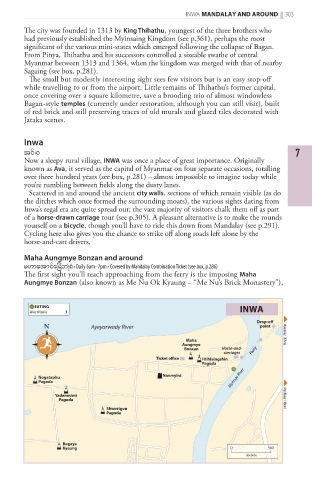
       The first sight you’ll reach approaching from the ferry is the imposing Maha
       Aungmye Bonzan (also known as Me Nu Ok Kyaung – “Me Nu’s Brick Monastery”),

         EATING                                          INWA
        Ave Maria  1
                                                             Drop-off
           N          Ayeyarwady River                        point
                                             Maha                   Mandalay  (17km)
                                            Aungmye
                                            Bonzan   Horse-and-
                                                     carriages  Ferry
                                      Ticket office   Htihlaingshin
                                                Pagoda
                                                       Myitnge River
          Nogataphu                    Nanmyint
          Pagoda
              Yadanasimi
               Pagoda                                               Mandalay  (18km)
                          Shwezigon
                          Pagoda

                Bagaya
                Kyaung                                 0        500
                                                           metres


   276-309_Myanmar_B2_Ch7.indd   303                           30/06/17   2:21 pm

