


Page 399 - The Rough Guide to Myanmar (Burma)
P. 399
Language CONTEXTS  397
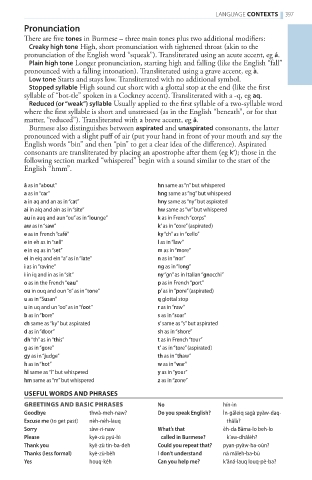
       Pronunciation
       There are five tones in Burmese – three main tones plus two additional modifiers:
        Creaky high tone High, short pronunciation with tightened throat (akin to the
       pronunciation of the English word “squeak”). Transliterated using an acute accent, eg á.
        Plain high tone Longer pronunciation, starting high and falling (like the English “fall”
       pronounced with a falling intonation). Transliterated using a grave accent, eg à.
        Low tone Starts and stays low. Transliterated with no additional symbol.
        Stopped syllable High sound cut short with a glottal stop at the end (like the first
       syllable of “bot-tle” spoken in a Cockney accent). Transliterated with a -q, eg aq.
        Reduced (or “weak”) syllable Usually applied to the first syllable of a two-syllable word
       where the first syllable is short and unstressed (as in the English “beneath”, or for that
       matter, “reduced”). Transliterated with a breve accent, eg ă.
        Burmese also distinguishes between aspirated and unaspirated consonants, the latter
       pronounced with a slight puff of air (put your hand in front of your mouth and say the
       English words “bin” and then “pin” to get a clear idea of the difference). Aspirated
       consonants are transliterated by placing an apostrophe after them (eg k’); those in the
       following section marked “whispered” begin with a sound similar to the start of the
       English “hmm”.

       ă as in “about”                hn same as “n” but whispered
       a as in “car”                  hng same as “ng” but whispered
       a in aq and an as in “cat”     hny same as “ny” but aspirated
       ai in aiq and ain as in “site”  hw same as “w” but whispered
       au in auq and aun “ou” as in “lounge”  k as in French “corps”
       aw as in “saw”                 k’ as in “core” (aspirated)
       e as in French “café”          ky “ch” as in “cello”
       e in eh as in “sell”           l as in “law”
       e in eq as in “set”            m as in “more”
       ei in eiq and ein “a” as in “late”  n as in “nor”
       i as in “ravine”               ng as in “long”
       i in iq and in as in “sit”     ny “gn” as in Italian “gnocchi”
       o as in the French “eau”       p as in French “port”
       ou in ouq and oun “o” as in “tone”  p’ as in “pore” (aspirated)
       u as in “Susan”                q glottal stop
       u in uq and un “oo” as in “foot”  r as in “raw”
       b as in “bore”                 s as in “soar”
       ch same as “ky” but aspirated  s’ same as “s” but aspirated
       d as in “door”                 sh as in “shore”
       dh “th” as in “this”           t as in French “tour”
       g as in “gore”                 t’ as in “tore” (aspirated)
       gy as in “judge”               th as in “thaw”
       h as in “hot”                  w as in “war”
       hl same as “l” but whispered   y as in “your”
       hm same as “m” but whispered   z as in “zone”
       USEFUL WORDS AND PHRASES
       GREETINGS AND BASIC PHRASES    No             hín-ìn
       Goodbye        thwà-meh-naw?   Do you speak English?   Ìn-găleiq sagà pyàw-daq-
       Excuse me (to get past)   nèh-nèh-lauq          thălà?
       Sorry          sàw-ri-naw      What’s that    èh-da Băma-lo beh-lo
       Please         kyè-zù pyú-bì    called in Burmese?   k’aw-dhălèh?
       Thank you      kyè-zù tin-ba-deh  Could you repeat that?   pyan-pyàw-ba-oùn?
       Thanks (less formal)   kyè-zù-bèh   I don’t understand   nà măleh-ba-bù
       Yes            houq-kéh        Can you help me?   k’ăná-lauq louq-pè-ba?


   356-402_Myanmar_B2_Contexts.indd   397                      30/06/17   2:22 pm

