


Page 16 - (DK) Help Your Kids with Growing Up: A No-Nonsense Guide to Puberty and Adolescence
P. 16
14        GR O WING  UP


        Teen brains                                                        SEE ALSO               16–17  ›

                                                                           Identity
                                                                           Thinking independently   18–19  ›
        Throughout childhood, the brain grows and develops, and by         Mood swings            20–21  ›
        the time a child is six years old, their brain has reached up to    Sleep                 76–77  ›
        90 per cent of its full adult size. During puberty, however, the
        brain experiences its most dramatic transformation, and in
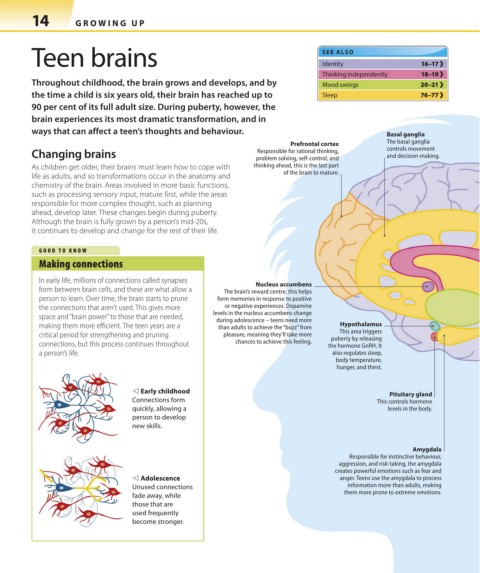
        ways that can affect a teen’s thoughts and behaviour.                             Basal ganglia
                                                                    Prefrontal cortex     The basal ganglia
        Changing brains                                     problem solving, self-control, and   controls movement
                                                            Responsible for rational thinking,
                                                                                          and decision-making.
        As children get older, their brains must learn how to cope with   thinking ahead, this is the last part
        life as adults, and so transformations occur in the anatomy and   of the brain to mature.
        chemistry of the brain. Areas involved in more basic functions,
        such as processing sensory input, mature first, while the areas
        responsible for more complex thought, such as planning
        ahead, develop later. These changes begin during puberty.
        Although the brain is fully grown by a person’s mid-20s,
        it continues to develop and change for the rest of their life.

          GOOD  T O  KNO W
          Making connections

          In early life, millions of connections called synapses   Nucleus accumbens
          form between brain cells, and these are what allow a   The brain’s reward centre, this helps
          person to learn. Over time, the brain starts to prune   form memories in response to positive
          the connections that aren’t used. This gives more   or negative experiences. Dopamine
          space and “brain power” to those that are needed,   levels in the nucleus accumbens change
                                                   during adolescence – teens need more
          making them more efficient. The teen years are a   than adults to achieve the “buzz” from   Hypothalamus
                                                                               This area triggers
          critical period for strengthening and pruning   pleasure, meaning they’ll take more   puberty by releasing
          connections, but this process continues throughout    chances to achieve this feeling.  the hormone GnRH. It
          a person’s life.                                                    also regulates sleep,
                                                                               body temperature,
                                                                               hunger, and thirst.

                               ◁ Early childhood                                           Pituitary gland
                               Connections form                                         This controls hormone
                               quickly, allowing a                                        levels in the body.
                               person to develop
                               new skills.

                                                                                                Amygdala
                                                                                  Responsible for instinctive behaviour,
                                                                               aggression, and risk-taking, the amygdala
                                                                              creates powerful emotions such as fear and
                               ◁ Adolescence                                   anger. Teens use the amygdala to process
                               Unused connections                                information more than adults, making
                               fade away, while                                 them more prone to extreme emotions.
                               those that are
                               used frequently
                               become stronger.


   014-015_Teen_brains.indd   14                                                                     24/03/2017   17:14

