


Page 17 - (DK) Help Your Kids with Growing Up: A No-Nonsense Guide to Puberty and Adolescence
P. 17
TEEN  BR AINS        15

                                        Being clumsy
                                        During puberty, growth spurts – when a teen grows quickly
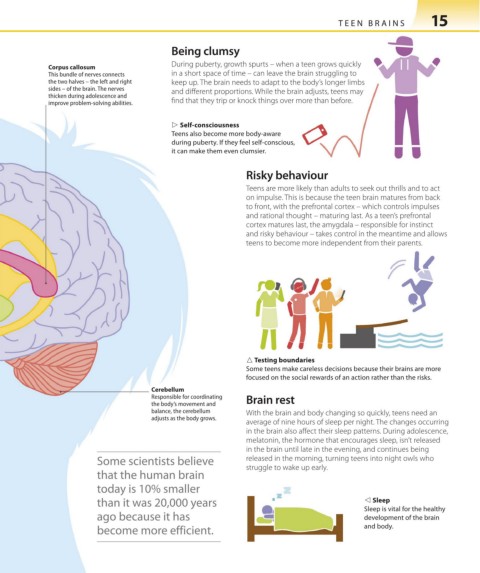
            Corpus callosum
            This bundle of nerves connects    in a short space of time – can leave the brain struggling to
            the two halves – the left and right   keep up. The brain needs to adapt to the body’s longer limbs
            sides – of the brain. The nerves   and different proportions. While the brain adjusts, teens may
            thicken during adolescence and
            improve problem-solving abilities.   find that they trip or knock things over more than before.

                                        ▷ Self-consciousness
                                        Teens also become more body-aware
                                        during puberty. If they feel self-conscious,
                                        it can make them even clumsier.

                                                          Risky behaviour
                                                          Teens are more likely than adults to seek out thrills and to act
                                                          on impulse. This is because the teen brain matures from back
                                                          to front, with the prefrontal cortex – which controls impulses
                                                          and rational thought – maturing last. As a teen’s prefrontal
                                                          cortex matures last, the amygdala – responsible for instinct
                                                          and risky behaviour – takes control in the meantime and allows
                                                          teens to become more independent from their parents.


                                                          △ Testing boundaries
                                                          Some teens make careless decisions because their brains are more
                                                          focused on the social rewards of an action rather than the risks.
                                    Cerebellum
                                    Responsible for coordinating    Brain rest
                                    the body’s movement and
                                    balance, the cerebellum    With the brain and body changing so quickly, teens need an
                                    adjusts as the body grows.  average of nine hours of sleep per night. The changes occurring
                                                          in the brain also affect their sleep patterns. During adolescence,
                                                          melatonin, the hormone that encourages sleep, isn’t released
                                                          in the brain until late in the evening, and continues being
                       Some scientists believe            released in the morning, turning teens into night owls who
                                                          struggle to wake up early.
                       that the human brain
                       today is 10% smaller
                       than it was 20,000 years                                      ◁ Sleep
                                                                                     Sleep is vital for the healthy
                       ago because it has                                            development of the brain
                       become more efficient.                                        and body.


   014-015_Teen_brains.indd   15                                                                     24/03/2017   17:14

