


Page 19 - (DK) Help Your Kids with Growing Up: A No-Nonsense Guide to Puberty and Adolescence
P. 19
IDENTIT Y        17


           “Today you are you, that is truer              How identity evolves
           than true.  There is no one alive              Young children usually talk about their identity in terms of their
                                                          appearance and what they do – for example, their hair colour
           who is youer than you”.                        or favourite sport. Older children tend to compare their
                                                          identities to others. A child might start to feel good about their
           Dr Seuss                                       talents or bad about their perceived weaknesses.
                                                           During adolescence, teens generally gain a more complex
                                                          sense of who they are. They might explain themselves in
                                                          greater depth – for example, that they are cheerful and
                                                          optimistic but that doesn’t mean they don’t feel down
                                                          sometimes. Many teens experiment to find out which identity
                                                          feels real to them. As they encounter new people and new
                                                          ideas, they learn, and their interests and views develop –
                                                          all of these factors contribute to their evolving identity.


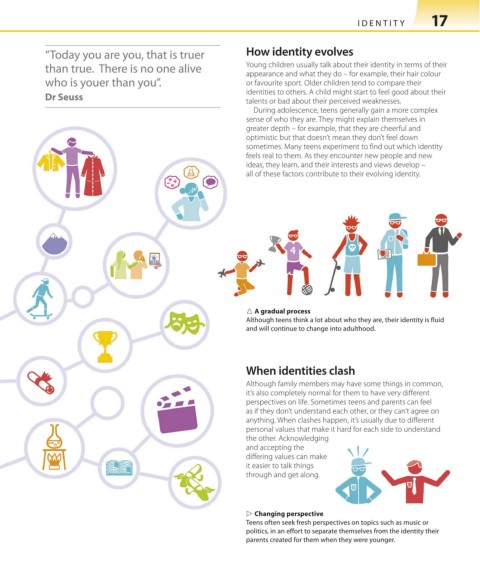
                                                          △ A gradual process
                                                          Although teens think a lot about who they are, their identity is fluid
                                                          and will continue to change into adulthood.


                                                          When identities clash

                                                          Although family members may have some things in common,
                                                          it’s also completely normal for them to have very different
                                                          perspectives on life. Sometimes teens and parents can feel
                                                          as if they don’t understand each other, or they can’t agree on
                                                          anything. When clashes happen, it’s usually due to different
                                                          personal values that make it hard for each side to understand
                                                          the other. Acknowledging
                                                          and accepting the
                                                          differing values can make
                                                          it easier to talk things
                                                          through and get along.


                                                          ▷ Changing perspective
                                                          Teens often seek fresh perspectives on topics such as music or
                                                          politics, in an effort to separate themselves from the identity their
                                                          parents created for them when they were younger.


   016-017_Identity.indd   17                                                                        24/03/2017   17:14

