


Page 236 - (DK) Help Your Kids with Growing Up: A No-Nonsense Guide to Puberty and Adolescence
P. 236
234       SEX


        Bacterial and parasitic STIs                                       SEE ALSO
                                                                           ‹
                                                                           ‹ 224–225  Sex
                                                                            230–231  Safer sex
        If someone has a sexually transmitted infection (STI, also         ‹ 232–233  Contraception
        known as a sexually transmitted disease), it can be spread         Viral STIs           236–237  ›
        by vaginal, oral, or anal sex. STIs can have a variety of causes,
        among them bacterial and parasitic infections.
                                                                  GOOD  T O  KNO W
        STI testing                                               What to expect
        Not all STIs cause symptoms, and it’s possible to have one without   An STI screening might involve a blood or urine test,
        knowing it. If a teen has had unprotected sex or is concerned they    a sample from the urethra or the vagina, or a genital
        may have an STI, they should visit a doctor or sexual health clinic    examination. You’ll also be asked some questions:
        to be tested. This is sometimes called “getting screened”. Clinics
        are confidential and available to everyone of all genders or ages.   • Why do you think you might have an STI?
          For some tests, the results are instantaneous; others might take a few   • When did you last have sex and have you ever
        weeks to come through. If a teen tests positive for an STI, they will be   had unprotected sex?
        given treatment, and should tell their partner and any previous partners.
                                                                  • What symptoms do you have, if any?


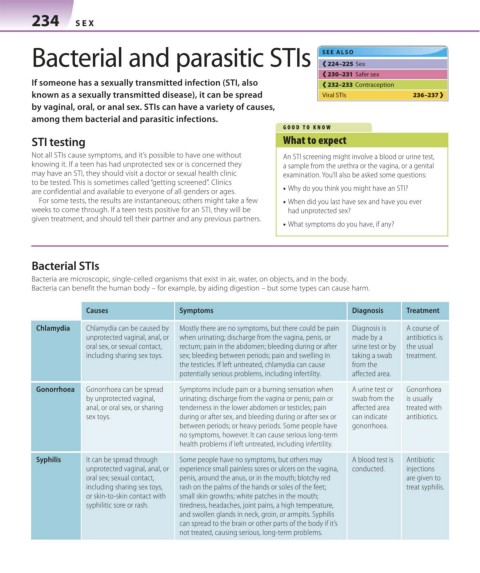
        Bacterial STIs

        Bacteria are microscopic, single-celled organisms that exist in air, water, on objects, and in the body.
        Bacteria can benefit the human body – for example, by aiding digestion – but some types can cause harm.

                     Causes               Symptoms                                Diagnosis    Treatment

         Chlamydia   Chlamydia can be caused by   Mostly there are no symptoms, but there could be pain   Diagnosis is   A course of
                     unprotected vaginal, anal, or   when urinating; discharge from the vagina, penis, or   made by a   antibiotics is
                     oral sex, or sexual contact,   rectum; pain in the abdomen; bleeding during or after   urine test or by   the usual
                     including sharing sex toys.  sex; bleeding between periods; pain and swelling in    taking a swab   treatment.
                                          the testicles. If left untreated, chlamydia can cause   from the
                                          potentially serious problems, including infertility.  affected area.

         Gonorrhoea  Gonorrhoea can be spread   Symptoms include pain or a burning sensation when   A urine test or   Gonorrhoea
                     by unprotected vaginal,   urinating; discharge from the vagina or penis; pain or   swab from the   is usually
                     anal, or oral sex, or sharing   tenderness in the lower abdomen or testicles; pain   affected area   treated with
                     sex toys.            during or after sex, and bleeding during or after sex or   can indicate   antibiotics.
                                          between periods; or heavy periods. Some people have   gonorrhoea.
                                          no symptoms, however. It can cause serious long-term
                                          health problems if left untreated, including infertility.

         Syphilis    It can be spread through   Some people have no symptoms, but others may   A blood test is   Antibiotic
                     unprotected vaginal, anal, or   experience small painless sores or ulcers on the vagina,   conducted.  injections
                     oral sex; sexual contact,   penis, around the anus, or in the mouth; blotchy red   are given to
                     including sharing sex toys,   rash on the palms of the hands or soles of the feet;   treat syphilis.
                     or skin-to-skin contact with   small skin growths; white patches in the mouth;
                     syphilitic sore or rash.  tiredness, headaches, joint pains, a high temperature,
                                          and swollen glands in neck, groin, or armpits. Syphilis
                                          can spread to the brain or other parts of the body if it’s
                                          not treated, causing serious, long-term problems.


   234-235_299754_HYKWGU_Bacterial_and_parasitic_STIs.indd   234                                     24/03/2017   17:20

