


Page 86 - (DK) Help Your Kids with Growing Up: A No-Nonsense Guide to Puberty and Adolescence
P. 86
84        HEALTH Y  MIND


        Emotions                                                           SEE ALSO
                                                                           ‹
                                                                           ‹ 20–21  Mood swings
                                                                            82–83  Positive mental health
        Emotions are instinctive, physical reactions to things that happen    Resilience          90–91  ›
        to or around a person. They’re triggered by chemicals released     Anxiety and depression   94–95  ›
        in the brain and lead to a person’s mental response – feelings.
        Emotions are universal, while feelings are individual and personal.


        Explaining emotions
        Emotions are natural human responses that help
        people interpret what they’re experiencing and how
        to react. Babies can sense their own emotions and
        respond to the emotions of others, through actions
        such as smiling, laughing, or crying – even if they can’t
        explain why they feel the way they feel. As children
        and teens grow, the physical reactions – laughing
        when happy, sweating when nervous, reddening when
        angry – remain largely the same, but they become
        better able to understand and express their emotions.
        This is because the parts of the brain responsible for
        rational thought develop during puberty.


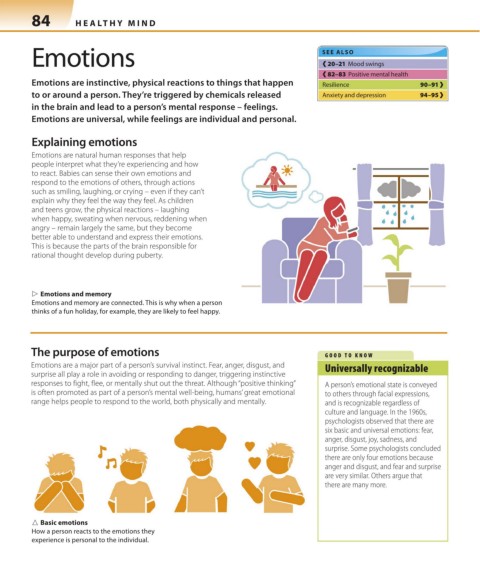
        ▷ Emotions and memory
        Emotions and memory are connected. This is why when a person
        thinks of a fun holiday, for example, they are likely to feel happy.


        The purpose of emotions                                             GOOD  T O  KNO W
        Emotions are a major part of a person’s survival instinct. Fear, anger, disgust, and   Universally recognizable
        surprise all play a role in avoiding or responding to danger, triggering instinctive
        responses to fight, flee, or mentally shut out the threat. Although “positive thinking”   A person’s emotional state is conveyed
        is often promoted as part of a person’s mental well-being, humans’ great emotional   to others through facial expressions,
        range helps people to respond to the world, both physically and mentally.   and is recognizable regardless of
                                                                            culture and language. In the 1960s,
                                                                            psychologists observed that there are
                                                                            six basic and universal emotions: fear,
                                                                            anger, disgust, joy, sadness, and
                                                                            surprise. Some psychologists concluded
                                                                            there are only four emotions because
                                                                            anger and disgust, and fear and surprise
                                                                            are very similar. Others argue that
                                                                            there are many more.


        △ Basic emotions
        How a person reacts to the emotions they
        experience is personal to the individual.


   084-085_Emotions.indd   84                                                                        24/03/2017   17:16

