


Page 107 - Atlas Of The World's Strangest Animals
P. 107
AMERICAN MINK            107


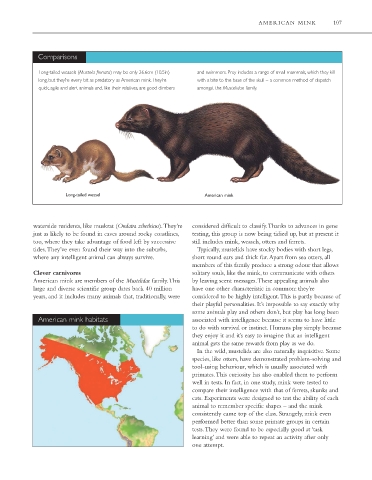
              Comparisons

              Long-tailed weasels (Mustela frenata) may be only 26.6cm (10.5in)  and swimmers. Prey includes a range of small mammals, which they kill
              long, but they’re every bit as predatory as American mink.They’re  with a bite to the base of the skull –a common method of dispatch
              quick, agile and alert animals and, like their relatives, are good climbers  amongst the Mustelidae family.


                        Long-tailed weasel                              American mink


             waterside residents, like muskrat (Ondatra zibethicus).They’re  considered difficult to classify.Thanks to advances in gene
             just as likely to be found in caves around rocky coastlines,  testing, this group is now being tidied up, but at present it
             too, where they take advantage of food left by successive  still includes mink, weasels, otters and ferrets.
             tides.They’ve even found their way into the suburbs,    Typically, mustelids have stocky bodies with short legs,
             where any intelligent animal can always survive.       short round ears and thick fur.Apart from sea otters, all
                                                                    members of this family produce a strong odour that allows
             Clever carnivores                                      solitary souls, like the mink, to communicate with others
             American mink are members of the Mustelidae family.This  by leaving scent messages.These appealing animals also
             large and diverse scientific group dates back 40 million  have one other characteristic in common: they’re
             years, and it includes many animals that, traditionally, were  considered to be highly intelligent.This is partly because of
                                                                    their playful personalities. It’s impossible to say exactly why
                                                                    some animals play and others don’t, but play has long been
              American mink habitats                                associated with intelligence because it seems to have little
                                                                    to do with survival or instinct. Humans play simply because
                                                                    they enjoy it and it’s easy to imagine that an intelligent
                                                                    animal gets the same rewards from play as we do.
                                                                     In the wild, mustelids are also naturally inquisitive. Some
                                                                    species, like otters, have demonstrated problem-solving and
                                                                    tool-using behaviour, which is usually associated with
                                                                    primates.This curiosity has also enabled them to perform
                                                                    well in tests. In fact, in one study, mink were tested to
                                                                    compare their intelligence with that of ferrets, skunks and
                                                                    cats. Experiments were designed to test the ability of each
                                                                    animal to remember specific shapes – and the mink
                                                                    consistently came top of the class. Strangely, mink even
                                                                    performed better than some primate groups in certain
                                                                    tests.They were found to be especially good at ‘task
                                                                    learning’ and were able to repeat an activity after only
                                                                    one attempt.


                                             (c) 2011 Marshall Cavendish. All Rights Reserved.

