


Page 111 - Atlas Of The World's Strangest Animals
P. 111
BIG BROWN BAT            111


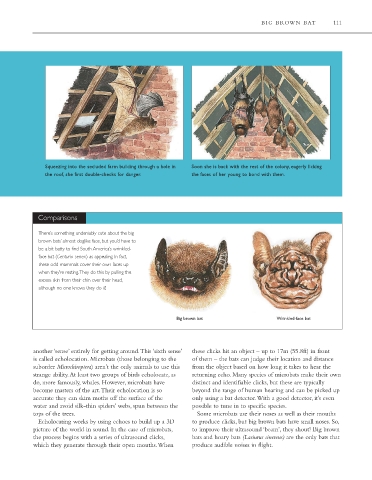
                 Squeezing into the secluded farm building through a hole in  Soon she is back with the rest of the colony, eagerly licking
                 the roof, she first double-checks for danger.     the faces of her young to bond with them.


              Comparisons


              There’s something undeniably cute about the big
              brown bats’ almost doglike face, but you’d have to
              be a bit batty to find South America’s wrinkled-
              face bat (Centurio senex) as appealing. In fact,
              these odd mammals cover their own faces up
              when they’re resting.They do this by pulling the
              excess skin from their chin over their head,
              although no one knows they do it!


                                                              Big brown bat                      Wrinkled-face bat


             another ‘sense’ entirely for getting around.This ‘sixth sense’  these clicks hit an object – up to 17m (55.8ft) in front
             is called echolocation. Microbats (those belonging to the  of them – the bats can judge their location and distance
             suborder Microchiroptera) aren’t the only animals to use this  from the object based on how long it takes to hear the
             strange ability.At least two groups of birds echolocate, as  returning echo. Many species of microbats make their own
             do, more famously, whales. However, microbats have     distinct and identifiable clicks, but these are typically
             become masters of the art.Their echolocation is so     beyond the range of human hearing and can be picked up
             accurate they can skim moths off the surface of the    only using a bat detector.With a good detector, it’s even
             water and avoid silk-thin spiders’ webs, spun between the  possible to tune in to specific species.
             tops of the trees.                                      Some microbats use their noses as well as their mouths
              Echolocating works by using echoes to build up a 3D   to produce clicks, but big brown bats have small noses. So,
             picture of the world in sound. In the case of microbats,  to improve their ultrasound ‘beam’, they shout! Big brown
             the process begins with a series of ultrasound clicks,  bats and hoary bats (Lasiurus cinereus) are the only bats that
             which they generate through their open mouths.When     produce audible noises in flight.


                                             (c) 2011 Marshall Cavendish. All Rights Reserved.

