


Page 110 - Atlas Of The World's Strangest Animals
P. 110
110      ATLAS  OF THE WORLD’S  STRANGEST ANIMALS


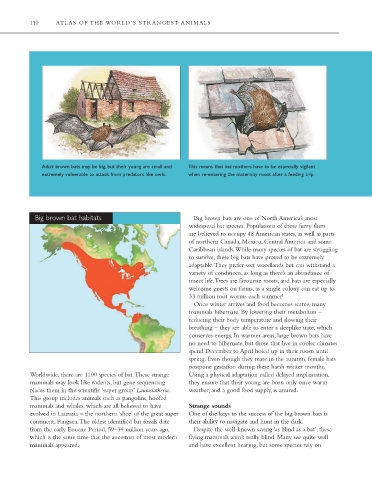
                Adult brown bats may be big, but their young are small and  This means that bat mothers have to be especially vigilant
                extremely vulnerable to attack from predators like owls.  when re-entering the maternity roost after a feeding trip.


             Big brown bat habitats                                 Big brown bats are one of North America’s most
                                                                  widespead bat species. Populations of these furry fliers
                                                                  are believed to occupy 48 American states, as well as parts
                                                                  of northern Canada, Mexico, Central America and some
                                                                  Caribbean islands.While many species of bat are struggling
                                                                  to survive, these big bats have proved to be extremely
                                                                  adaptable.They prefer wet woodlands but can withstand a
                                                                  variety of conditions, as long as there’s an abundance of
                                                                  insect life.Trees are favourite roosts, and bats are especially
                                                                  welcome guests on farms, as a single colony can eat up to
                                                                  33 million root worms each summer!
                                                                    Once winter arrives and food becomes scarce, many
                                                                  mammals hibernate. By lowering their metabolism –
                                                                  reducing their body temperature and slowing their
                                                                  breathing – they are able to enter a sleeplike state, which
                                                                  conserves energy. In warmer areas, large brown bats have
                                                                  no need to hibernate, but those that live in cooler climates
                                                                  spend December to April holed up in their roosts until
                                                                  spring. Even though they mate in the autumn, female bats
                                                                  postpone gestation during these harsh winter months.
           Worldwide, there are 1100 species of bat.These strange  Using a physical adaptation called delayed implantation,
           mammals may look like rodents, but gene sequencing     they ensure that their young are born only once warm
           places them in the scientific ‘super group’ Laurasiatheria.  weather, and a good food supply, is assured.
           This group includes animals such as pangolins, hoofed
           mammals and whales, which are all believed to have     Strange sounds
           evolved in Laurasia – the northern ‘slice’ of the great super  One of the keys to the success of the big brown bats is
           continent, Pangaea.The oldest identified bat fossils date  their ability to navigate and hunt in the dark.
           from the early Eocene Period, 59–34 million years ago,   Despite the well-known saying ‘as blind as a bat’, these
           which is the same time that the ancestors of most modern  flying mammals aren’t really blind. Many see quite well
           mammals appeared.                                      and have excellent hearing, but some species rely on


                                             (c) 2011 Marshall Cavendish. All Rights Reserved.

