


Page 12 - Atlas Of The World's Strangest Animals
P. 12
12       ATLAS  OF THE WORLD’S  STRANGEST ANIMALS


           ‘Aardvark’ is famously one of the first words you’ll find in
                                                                    Aardvark habitats
           an English language dictionary.The name comes from
           Dutch Afrikaans and means ‘earth pig’, which is exactly
           what European settlers thought these strange mammals
           looked like. However, although these shy and solitary
           creatures do have piglike bodies, they’re no relation.
           In fact, genetically speaking, aardvarks are a puzzle.
             When classifying living things, scientists begin by
           looking for similarities between known species. But can
           you think of any other burrowing, nocturnal mammal that
           has a powerful tail, rabbit-like ears, webbed toes, claws
           resembling hooves and a long sticky tongue? It’s a problem
           that has stumped scientists for decades.
             Initially, the solution was to choose a ‘best fit’ by placing
           the aardvark in the same order as armadillos and sloths
           (Edentata). Later, a new order was created especially for the
           aardvark – Tubulidentata. Edentata means ‘toothless ones’
           and armadillos and sloths both lack front, incisor teeth.
           Adult aardvarks have no front teeth either, but they do  seem to be living fossils.They may have been very
           possess extremely odd ‘cheek teeth’ at the back of their  successful as a species, but they’re an evolutionary dead
           jaws. In place of the usual ‘pulp’ in the centre of each  end.They have distant relatives today, including
           tooth are fine tubes bound together by a hard substance  elephants, and their common ancestor probably dates
           called cementum. Hence the name ‘Tubulidentata’, meaning  back to the moment when the African continent split
           tube-toothed.                                          from the other landmasses.
             To date, the aardvark is the only known member of the
           order ‘Tubulidentata’ and the situation is likely to remain  Terrific tunnellers
           that way.Although a few fossilized remains have been   From grassy plains to woodland scrub, aardvarks enjoy
           found, they provide no clues to the aardvarks’ ancestry or  a variety of habitats, but you’re unlikely ever to see one
           their relationship to other species.These curious beasts  ‘in the flesh’.That’s because they spend much of the day


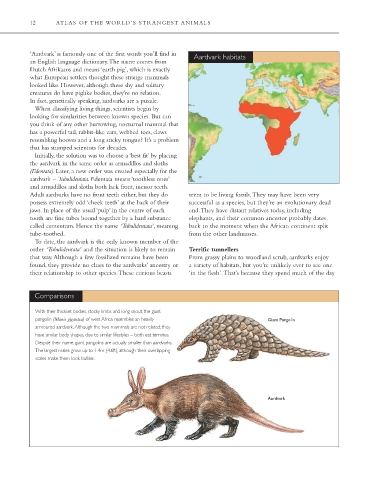
             Comparisons


             With their thickset bodies, stocky limbs and long snout, the giant
             pangolin (Manis gigantea) of west Africa resembles an heavily                    Giant Pangolin
             armoured aardvark.Although the two mammals are not related, they
             have similar body shapes, due to similar lifestyles – both eat termites.
             Despite their name, giant pangolins are actually smaller than aardvarks.
             The largest males grow up to 1.4m (4.6ft), although their overlapping
             scales make them look bulkier.


                                                                                              Aardvark


                                             (c) 2011 Marshall Cavendish. All Rights Reserved.

