


Page 16 - Atlas Of The World's Strangest Animals
P. 16
16       ATLAS  OF THE WORLD’S  STRANGEST ANIMALS


           We are all shaped by our environment. However, in the  they are still good climbers). Instead, their feet are designed
           sand dunes of south-west Africa there is a species of gecko  to spread their weight so that they don’t sink into the
           that has evolved some very unusual characteristics to cope  sand.Their webbed feet also have an handy, extra ‘feature’.
           with desert living.                                    They contain small cartilages – stiff connecting tissues –
             Geckos are found in warm, tropical regions. In Africa  that support a complex system of muscles.These allow the
           alone, there are approximately 41 species.Around eight are  geckos’ feet to make highly coordinated movements. So, to
           found in the area of the Namib–Naukluft National Park,  escape the baking heat of the midday sun, they simply chill
           part of the Namib Desert, which is thought to be the   out in burrows that they’ve specially dug for the purpose.
           world’s oldest desert. Many of these are arboreal species  Their foot design makes them superb tunnellers, and these
           and have famously bristly feet, which enable them to   burrows can be up to 50cm (19.7in) long.
           ‘stick’ to almost any surface.As their name suggests,    Our web-footed friends also have several other physical
           though, Namib web-footed geckos have their own special  adaptations that make them real desert specialists. Most
           adaptation to survive in the desert sands.             geckos, especially the stunningly vibrant day geckos (genus
             Unlike their tree-dwelling cousins, web-footed geckos  Phelsuma), are extremely colourful and, ironically, this helps
           don’t need to be able to cling to vertical surfaces (although  them to blend in with the rich colours of the rainforest. In


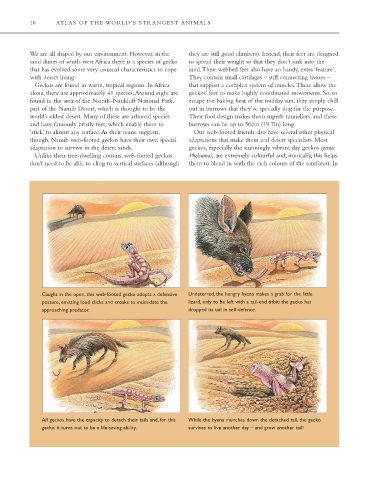
                Caught in the open, this web-footed gecko adopts a defensive  Undeterred, the hungry hyena makes a grab for the little
                posture, emitting loud clicks and croaks to intimidate the  lizard, only to be left with a tail-end titbit: the gecko has
                approaching predator.                             dropped its tail in self-defence.


                All geckos have the capacity to detach their tails and, for this  While the hyena munches down the detached tail, the gecko
                gecko, it turns out to be a life-saving ability.  survives to live another day – and grow another tail!


                                             (c) 2011 Marshall Cavendish. All Rights Reserved.

