


Page 17 - Atlas Of The World's Strangest Animals
P. 17
NAMIB WEB-FOOTED  GECKO                 17


              Comparisons

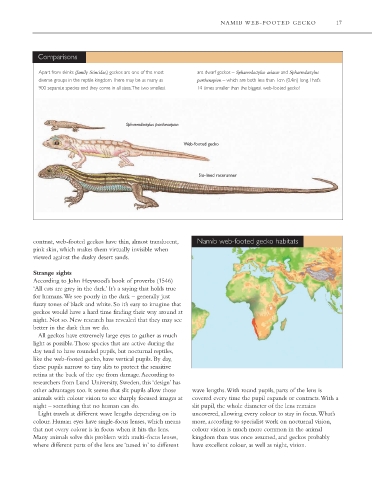
              Apart from skinks (family Scincidae),geckos are one of the most  are dwarf geckos – Sphaerodactylus ariasae and Sphaerodactylus
              diverse groups in the reptile kingdom.There may be as many as   parthenopion – which are both less than 1cm (0.4in) long.That’s
              900 separate species and they come in all sizes.The two smallest   14 times smaller than the biggest web-footed gecko!


                                             Sphaerodactylus parthenopion


                                                                 Web-footed gecko


                                                                      Six-lined racerunner


             contrast, web-footed geckos have thin, almost translucent,  Namib web-footed gecko habitats
             pink skin, which makes them virtually invisible when
             viewed against the dusky desert sands.

             Strange sights
             According to John Heywood’s book of proverbs (1546)
             ‘All cats are grey in the dark.’ It’s a saying that holds true
             for humans.We see poorly in the dark – generally just
             fuzzy tones of black and white. So it’s easy to imagine that
             geckos would have a hard time finding their way around at
             night. Not so. New research has revealed that they may see
             better in the dark than we do.
              All geckos have extremely large eyes to gather as much
             light as possible.Those species that are active during the
             day tend to have rounded pupils, but nocturnal reptiles,
             like the web-footed gecko, have vertical pupils. By day,
             these pupils narrow to tiny slits to protect the sensitive
             retina at the back of the eye from damage.According to
             researchers from Lund University, Sweden, this ‘design’ has
             other advantages too. It seems that slit pupils allow those  wave lengths.With round pupils, parts of the lens is
             animals with colour vision to see sharply focused images at  covered every time the pupil expands or contracts.With a
             night – something that no human can do.                slit pupil, the whole diameter of the lens remains
              Light travels at different wave lengths depending on its  uncovered, allowing every colour to stay in focus.What’s
             colour. Human eyes have single-focus lenses, which means  more, according to specialist work on nocturnal vision,
             that not every colour is in focus when it hits the lens.  colour vision is much more common in the animal
             Many animals solve this problem with multi-focus lenses,  kingdom than was once assumed, and geckos probably
             where different parts of the lens are ‘tuned in’ to different  have excellent colour, as well as night, vision.


                                             (c) 2011 Marshall Cavendish. All Rights Reserved.

