


Page 137 - Atlas Of The World's Strangest Animals
P. 137
HOATZIN         137


                                                                    coarse call. However, these beautiful birds have another
              Hoatzin habitats
                                                                    name – just as descriptive as their scientific and common
                                                                    names – but not nearly as flattering.They’re known as
                                                                    stink birds!
                                                                     The reason they’ve earned such an appalling appellation
                                                                    is due to their strange digestive system. For birds, digestion
                                                                    starts at the bill.This specialist tool is used for breaking
                                                                    open and grinding up food, and it eliminates the need for
                                                                    teeth. Once food has been cracked and crushed, it travels
                                                                    down to the crop, which is a muscular pouch in the
                                                                    throat. Most birds have a crop and it’s used both to soften
                                                                    food and to regulate how quickly it moves on to the
                                                                    gizzard.This enables birds to gorge themselves when food
                                                                    is plentiful and store any ‘excess’ for later. Once food
                                                                    reaches the gizzard (really a specialized stomach), muscles
                                                                    grind it up. Some birds swallow stones, using them to help
                                                                    this process along.
                                                                     What makes hoatzins so curious is that their crop is
                                                                    huge. In fact, it is so big that their flight muscles have been
                                                                    reduced to make space for it. It’s here that much of the
             struggling to survive as their habitats are gradually lost   hoatzins’ meal is broken down, but not in the usual way.
             to development.                                        Uniquely for birds, hoatzins use bacterial fermentation,
                                                                    like cattle, to digest their food. In cows, this process takes
             The stink bird!                                        place in a special chamber called the rumen (which is why
             The hoatzins’ scientific name, Opisthocomus hoazin, comes  cattle are called ruminants). Hoatzins don’t have this, so
             from the Greek for ‘wearing long hair behind’, a reference  fermentation takes place in the crop.All this produces a
             to its crest.The word hoatzin is said to be an         distinctive farmyard odour. Put simply, hoatzin smell
             onomatopoeic attempt to mimic the bird’s distinctive,  like manure!


              Comparisons

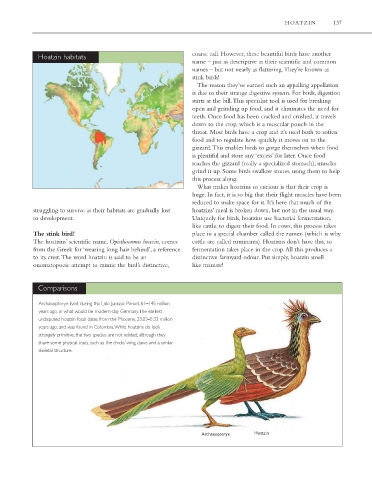
              Archaeopteryx lived during the Late Jurassic Period, 61–145 million
              years ago, in what would be modern-day Germany.The earliest
              undisputed hoatzin fossil dates from the Miocene, 23.03–5.33 million
              years ago, and was found in Colombia.While hoatzins do look
              strangely primitive, the two species are not related, although they
              share some physical traits, such as the chicks’ wing claws and a similar
              skeletal structure.


                                                                       Archaeopteryx     Hoatzin


                                             (c) 2011 Marshall Cavendish. All Rights Reserved.

