


Page 140 - Atlas Of The World's Strangest Animals
P. 140
140      ATLAS  OF THE WORLD’S  STRANGEST ANIMALS


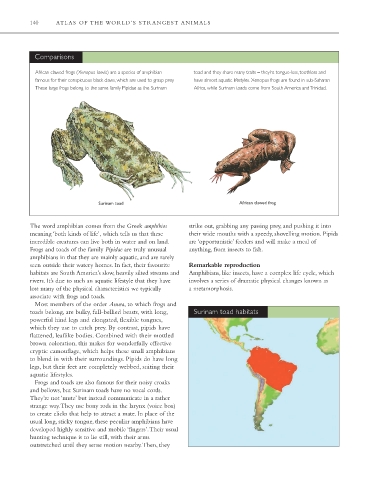
             Comparisons

             African clawed frogs (Xenopus laevis) are a species of amphibian  toad and they share many traits – they’re tongue-less, toothless and
             famous for their conspicuous black claws, which are used to grasp prey.  have almost aquatic lifestyles. Xenopus frogs are found in sub-Saharan
             These large frogs belong to the same family Pipidae as the Surinam  Africa, while Surinam toads come from South America and Trinidad.


                                   Surinam toad                                     African clawed frog


           The word amphibian comes from the Greek amphibios      strike out, grabbing any passing prey, and pushing it into
           meaning ‘both kinds of life’, which tells us that these  their wide mouths with a speedy, shovelling motion. Pipids
           incredible creatures can live both in water and on land.  are ‘opportunistic’ feeders and will make a meal of
           Frogs and toads of the family Pipidae are truly unusual  anything, from insects to fish.
           amphibians in that they are mainly aquatic, and are rarely
           seen outside their watery homes. In fact, their favourite  Remarkable reproduction
           habitats are South America’s slow, heavily silted streams and  Amphibians, like insects, have a complex life cycle, which
           rivers. It’s due to such an aquatic lifestyle that they have  involves a series of dramatic physical changes known as
           lost many of the physical characteristics we typically  a metamorphosis.
           associate with frogs and toads.
             Most members of the order Anura, to which frogs and
           toads belong, are bulky, full-bellied beasts, with long,  Surinam toad habitats
           powerful hind legs and elongated, flexible tongues,
           which they use to catch prey. By contrast, pipids have
           flattened, leaflike bodies. Combined with their mottled
           brown coloration, this makes for wonderfully effective
           cryptic camouflage, which helps these small amphibians
           to blend in with their surroundings. Pipids do have long
           legs, but their feet are completely webbed, suiting their
           aquatic lifestyles.
             Frogs and toads are also famous for their noisy croaks
           and bellows, but Surinam toads have no vocal cords.
           They’re not ‘mute’ but instead communicate in a rather
           strange way.They use bony rods in the larynx (voice box)
           to create clicks that help to attract a mate. In place of the
           usual long, sticky tongue, these peculiar amphibians have
           developed highly sensitive and mobile ‘fingers’.Their usual
           hunting technique is to lie still, with their arms
           outstretched until they sense motion nearby.Then, they


                                             (c) 2011 Marshall Cavendish. All Rights Reserved.

