


Page 21 - Atlas Of The World's Strangest Animals
P. 21
GIRAFFE         21


             do look like they are made from bits and pieces taken
                                                                     Giraffe habitats
             from other beasts.
              Such an eclectic mix of body parts has, however, made
             the giraffe one of the African savannah’s great success
             stories.A long neck means that they can feed on foliage
             not accessible to other animals.Their prehensile (gripping)
             tongue and mobile lips enable them to pull hard to reach
             buds and leaves into the mouth with ease.Their coat
             provides them with superb cryptic camouflage, so they
             can blend in with the dry grasses of the African plains.
             Their hooves are powerful enough to crush the skull of a
             lion or break its spine, although giraffes are rarely
             bothered by predators. Instead, their long legs simply
             carry them out of trouble at speeds of up to 56km/h
             (35mph).
              Their closest relatives – the okapi (Okapia johnstoni) – are
             equally odd.Their front half resembles a short, brown
             giraffe.The back looks like a zebra!

             Tall tales                                              Comparisons
             Thanks to their long legs and elongated necks, giraffes are
             the world’s tallest mammals.The tallest-ever giraffe
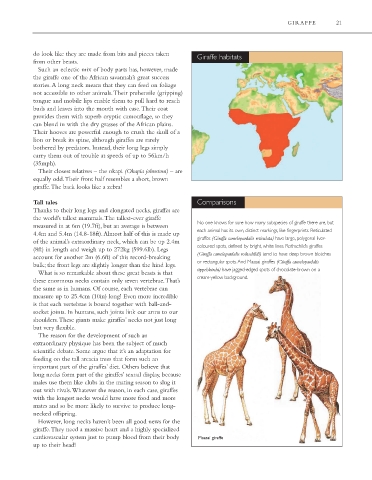
                                                                     No one knows for sure how many subspecies of giraffe there are, but
             measured in at 6m (19.7ft), but an average is between
                                                                     each animal has its own, distinct markings, like fingerprints. Reticulated
             4.4m and 5.4m (14.8-18ft).Almost half of this is made up
                                                                     giraffes (Giraffa camelopardalis reticulata) have large, polygonal liver-
             of the animal’s extraordinary neck, which can be up 2.4m
                                                                     coloured spots, defined by bright, white lines. Rothschild’s giraffes
             (8ft) in length and weigh up to 272kg (599.6lb). Legs
                                                                     (Giraffa camelopardalis rothschildi) tend to have deep brown blotches
             account for another 2m (6.6ft) of this record-breaking
                                                                     or rectangular spots.And Maasai giraffes (Giraffa camelopardalis
             bulk; the front legs are slightly longer than the hind legs.
                                                                     tippelskirchi) have jagged-edged spots of chocolate-brown on a
              What is so remarkable about these great beasts is that
                                                                     cream-yellow background.
             these enormous necks contain only seven vertebrae.That’s
             the same as in humans. Of course, each vertebrae can
             measure up to 25.4cm (10in) long! Even more incredible
             is that each vertebrae is bound together with ball-and-
             socket joints. In humans, such joints link our arms to our
             shoulders.These giants make giraffes’ necks not just long
             but very flexible.
              The reason for the development of such an
             extraordinary physique has been the subject of much
             scientific debate. Some argue that it’s an adaptation for
             feeding on the tall arcacia trees that form such an
             important part of the giraffes’ diet. Others believe that
             long necks form part of the giraffes’ sexual display, because
             males use them like clubs in the mating season to slug it
             out with rivals.Whatever the reason, in each case, giraffes
             with the longest necks would have more food and more
             mates and so be more likely to survive to produce long-
             necked offspring.
              However, long necks haven’t been all good news for the
             giraffe.They need a massive heart and a highly specialized
             cardiovascular system just to pump blood from their body  Maasai giraffe
             up to their head!


                                             (c) 2011 Marshall Cavendish. All Rights Reserved.

