


Page 220 - Atlas Of The World's Strangest Animals
P. 220
220      ATLAS  OF THE WORLD’S  STRANGEST ANIMALS


                                                                  throughout the body. Unlike most fish, they swim upright,
             Seahorse habitats
                                                                  using a small dorsal fin, like a stabilizer, to keep them
                                                                  vertical as well as to propel them forwards. In most fish,
                                                                  dorsal fins are made of thin tissue supported by rods of
                                                                  cartilage, but the seahorses’ fin is an extension of its
                                                                  backbone. Pectoral fins behind the eyes help them to steer.
                                                                  This odd ‘design’ means that seahorses are poor swimmers
                                                                  and are often found amongst clumps of sea grass or coral,
                                                                  with their prehensile tail wrapped around foliage to keep
                                                                  them stationary.
                                                                    Their eyes are positioned on either side of the head and
                                                                  can be swivelled in the socket, like a chameleon’s (see
                                                                  pages 26–29).This gives seahorses a wide field of vision
                                                                  and helps them to look out for predators and prey.
                                                                  Although they’re small, their bony skin offers some
                                                                  protection from danger, as does their natural camouflage.
                                                                  Most seahorses come in ‘sea shades’ – browns, greens and
                                                                  yellows, which easily blend in with the marine
                                                                  environment.They are able to change their skin colour,
                                                                  too, but are just as likely to do this in social situations as
                                                                  to protect themselves from danger.
           These graceful marine ‘horses’ are one of the most       The seahorses’ oddest physical characteristic, though, is
           distinctive and easily recognized species of fish.They’re  also their most famous. It is the males, not the females,
           also one of the oddest.                                who give birth.The reason for this is uncertain, but it’s
             Seahorses get their common name because they look    possible that it enables more matings to take place.
           like miniature horses, but that’s where any resemblance
           ends.These beautiful animals are bony fish, with a     Pairing up
           backbone, though no scales. Instead, their thin skin is  The sight of a pair of courting seahorses is one of the
           stretched over bony plates, which are positioned       ocean’s most moving spectacles.


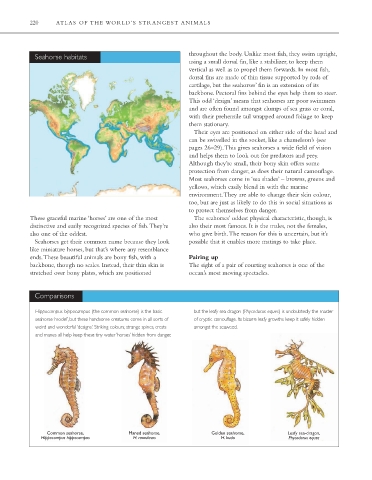
             Comparisons


             Hippocampus hippocampus (the common seahorse) is the basic  but the leafy sea dragon (Phycodurus eques) is undoubtedly the master
             seahorse ‘model’, but these handsome creatures come in all sorts of  of cryptic camouflage. Its bizarre leafy growths keep it safely hidden
             weird and wonderful ‘designs’. Striking colours, strange spines, crests  amongst the seaweed.
             and manes all help keep these tiny water ‘horses’ hidden from danger,


                 Common seahorse,             Maned seahorse,             Golden seahorse,           Leafy sea-dragon,
               Hippocampus hippocampus         H. ramulosus                   H. kuda                Phycodorus eques


                                             (c) 2011 Marshall Cavendish. All Rights Reserved.

