


Page 216 - Atlas Of The World's Strangest Animals
P. 216
216      ATLAS  OF THE WORLD’S  STRANGEST ANIMALS


           With their bold colours and flower-like shape, it’s easy to
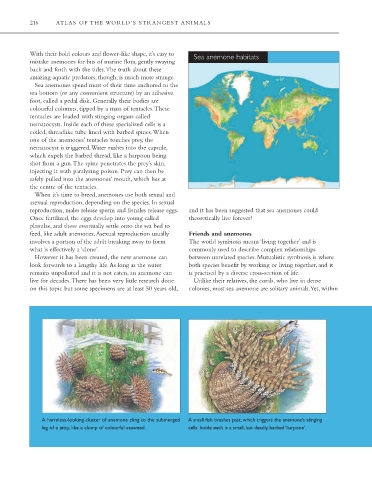
                                                                    Sea anemone habitats
           mistake anemones for bits of marine flora, gently swaying
           back and forth with the tides.The truth about these
           amazing aquatic predators, though, is much more strange.
             Sea anemones spend most of their time anchored to the
           sea bottom (or any convenient structure) by an adhesive
           foot, called a pedal disk. Generally their bodies are
           colourful columns, tipped by a mass of tentacles.These
           tentacles are loaded with stinging organs called
           nematocysts. Inside each of these specialized cells is a
           coiled, threadlike tube lined with barbed spines.When
           one of the anemones’ tentacles touches prey, the
           nematocyst is triggered.Water rushes into the capsule,
           which expels the barbed thread, like a harpoon being
           shot from a gun.The spine penetrates the prey’s skin,
           injecting it with paralyzing poison. Prey can then be
           safely pulled into the anemones’ mouth, which lies at
           the centre of the tentacles.
             When it’s time to breed, anemones use both sexual and
           asexual reproduction, depending on the species. In sexual
           reproduction, males release sperm and females release eggs.  and it has been suggested that sea anemones could
           Once fertilized, the eggs develop into young called    theoretically live forever!
           planulae, and these eventually settle onto the sea bed to
           feed, like adult anemones.Asexual reproduction usually  Friends and anemones
           involves a portion of the adult breaking away to form  The world symbiosis means ‘living together’ and is
           what is effectively a ‘clone’.                         commonly used to describe complex relationships
             However it has been created, the new anemone can     between unrelated species. Mutualistic symbiosis is where
           look forwards to a lengthy life.As long as the water   both species benefit by working or living together, and it
           remains unpolluted and it is not eaten, an anemone can  is practised by a diverse cross-section of life.
           live for decades.There has been very little research done  Unlike their relatives, the corals, who live in dense
           on this topic but some specimens are at least 50 years old,  colonies, most sea anemone are solitary animals.Yet, within


                A harmless-looking cluster of anemone cling to the submerged  A small fish brushes past,which triggers the anemone’s stinging
                leg of a jetty, like a clump of colourful seaweed.  cells. Inside each is a small, but deadly, barbed ‘harpoon’.


                                             (c) 2011 Marshall Cavendish. All Rights Reserved.

