


Page 38 - Atlas Of The World's Strangest Animals
P. 38
38       ATLAS  OF THE WORLD’S  STRANGEST ANIMALS


           More people in Africa are killed by hippopotami than by
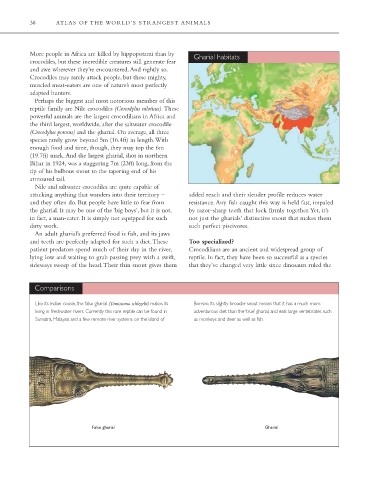
                                                                    Gharial habitats
           crocodiles, but these incredible creatures still generate fear
           and awe wherever they’re encountered.And rightly so.
           Crocodiles may rarely attack people, but these mighty,
           muscled meat-eaters are one of nature’s most perfectly
           adapted hunters.
             Perhaps the biggest and most notorious member of this
           reptile family are Nile crocodiles (Crocodylus niloticus). These
           powerful animals are the largest crocodilians in Africa and
           the third largest, worldwide, after the saltwater crocodile
           (Crocodylus porosus) and the gharial. On average, all three
           species rarely grow beyond 5m (16.4ft) in length.With
           enough food and time, though, they may top the 6m
           (19.7ft) mark.And the largest gharial, shot in northern
           Bihar in 1924, was a staggering 7m (23ft) long, from the
           tip of his bulbous snout to the tapering end of his
           armoured tail.
             Nile and saltwater crocodiles are quite capable of
           attacking anything that wanders into their territory –  added reach and their slender profile reduces water
           and they often do. But people have little to fear from   resistance. Any fish caught this way is held fast, impaled
           the gharial. It may be one of the ‘big boys’, but it is not,  by razor-sharp teeth that lock firmly together.Yet, it’s
           in fact, a man-eater. It is simply not equipped for such  not just the gharials’ distinctive snout that makes them
           dirty work.                                            such perfect piscivores.
             An adult gharial’s preferred food is fish, and its jaws
           and teeth are perfectly adapted for such a diet.These  Too specialized?
           patient predators spend much of their day in the river,  Crocodilians are an ancient and widespread group of
           lying low and waiting to grab passing prey with a swift,  reptile. In fact, they have been so successful as a species
           sideways sweep of the head.Their thin snout gives them  that they’ve changed very little since dinosaurs ruled the


             Comparisons

             Like its Indian cousin, the false gharial (Tomistoma schlegelii) makes its  Borneo. Its slightly broader snout means that it has a much more
             living in freshwater rivers. Currently this rare reptile can be found in  adventurous diet than the ‘true’ gharial, and eats large vertebrates such
             Sumatra, Malaysia and a few remote river systems on the island of  as monkeys and deer as well as fish.


                                 False gharial                                               Gharial


                                             (c) 2011 Marshall Cavendish. All Rights Reserved.

