


Page 43 - Atlas Of The World's Strangest Animals
P. 43
JAPANESE MACAQUE              43


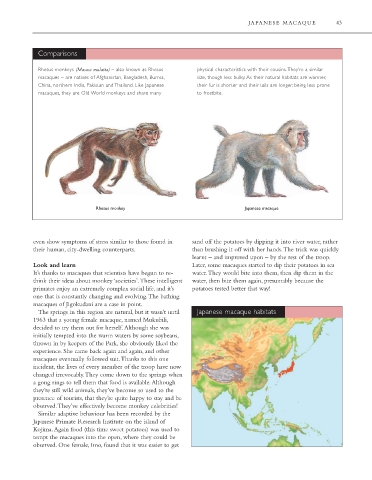
              Comparisons


              Rhesus monkeys (Macaca mulatta) – also known as Rhesus  physical characteristics with their cousins.They’re a similar
              macaques –are natives of Afghanistan, Bangladesh, Burma,  size, though less bulky. As their natural habitats are warmer,
              China, northern India, Pakistan and Thailand. Like Japanese  their fur is shorter and their tails are longer, being less prone
              macaques, they are Old World monkeys and share many    to frostbite.


                                  Rhesus monkey                                       Japanese macaque


             even show symptoms of stress similar to those found in  sand off the potatoes by dipping it into river water, rather
             their human, city-dwelling counterparts.               than brushing it off with her hands.The trick was quickly
                                                                    learnt – and improved upon – by the rest of the troop.
             Look and learn                                         Later, some macaques started to dip their potatoes in sea
             It’s thanks to macaques that scientists have begun to re-  water.They would bite into them, then dip them in the
             think their ideas about monkey ‘societies’.These intelligent  water, then bite them again, presumably because the
             primates enjoy an extremely complex social life, and it’s  potatoes tested better that way!
             one that is constantly changing and evolving.The bathing
             macaques of Jigokudani are a case in point.
              The springs in this region are natural, but it wasn’t until  Japanese macaque habitats
             1963 that a young female macaque, named Mukubili,
             decided to try them out for herself.Although she was
             initially tempted into the warm waters by some soybeans,
             thrown in by keepers of the Park, she obviously liked the
             experience. She came back again and again, and other
             macaques eventually followed suit.Thanks to this one
             incident, the lives of every member of the troop have now
             changed irrevocably.They come down to the springs when
             a gong rings to tell them that food is available.Although
             they’re still wild animals, they’ve become so used to the
             presence of tourists, that they’re quite happy to stay and be
             observed.They’ve effectively become monkey celebrities!
              Similar adaptive behaviour has been recorded by the
             Japanese Primate Research Institute on the island of
             Kojima.Again food (this time sweet potatoes) was used to
             tempt the macaques into the open, where they could be
             observed. One female, Imo, found that it was easier to get


                                             (c) 2011 Marshall Cavendish. All Rights Reserved.

