


Page 62 - Atlas Of The World's Strangest Animals
P. 62
62       ATLAS  OF THE WORLD’S  STRANGEST ANIMALS


           Deep in the forests of south-east Asia live the descendants  see one of these rare and beautiful animals, we’d
           of an ancient line of primates, which can be traced back,  immediately notice how perfectly their bodies have
           through the fossil record, to the Eocene epoch, some   developed to make the best of their environment.
           55.8–33.9 million years ago.This makes them unique. No   Their hands and feet, for instance, are long and dextrous,
           other primate can be traced so clearly back to their   with the added advantage of fleshy pads on the tips of
           ancient origins – and the tarsier seems to have changed  their fingers and toes to give a better grip on branches.
           little during this time.                               Their hind legs are also extremely long and designed for
             Tarsiers are extremely shy creatures, and active mainly at  bounding from branch to branch.Their leaping abilities
           night, which means that they spend the daytime holed up  are legendary and on average they can cover 2m (6.6ft)
           in tree cavities or hiding amongst lush vegetation.Their  with a single bound. During the course of these impressive
           favourite place to be is asleep, upright, against a tree trunk  acrobatics, they twist their bodies in the air and extend
           or branch, using their tail for support. Naturally they’re  their fingers, ready to grasp the nearest branch.
           found in dense thickets of bamboo, rainforests and     This peculiar mode of locomotion is aided by the tarsiers’
           plantations, which makes them even harder to spot      elongated ankle bones, which work just like shock
           amongst the thick foliage.Yet, if we were lucky enough to  absorbers, to prevent injuries as they flit through the


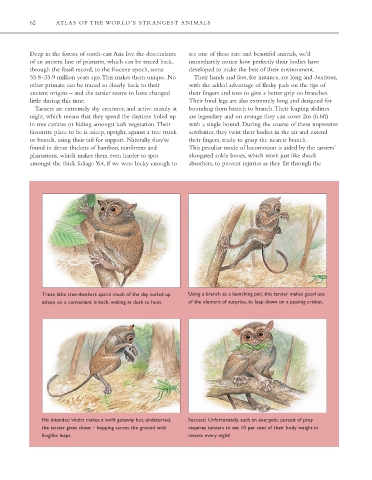
                These lithe tree-dwellers spend much of the day curled up  Using a branch as a launching pad, this tarsier makes good use
                asleep on a convenient branch,waking at dusk to hunt.  of the element of surprise, to leap down on a passing cricket.


                His intended victim makes a swift getaway but, undeterred,  Success! Unfortunately, such an energetic pursuit of prey
                the tarsier gives chase – hopping across the ground with  requires tarsiers to eat 10 per cent of their body weight in
                froglike leaps.                                   insects every night!


                                             (c) 2011 Marshall Cavendish. All Rights Reserved.

