


Page 63 - Atlas Of The World's Strangest Animals
P. 63
TARSIER          63


              Comparisons

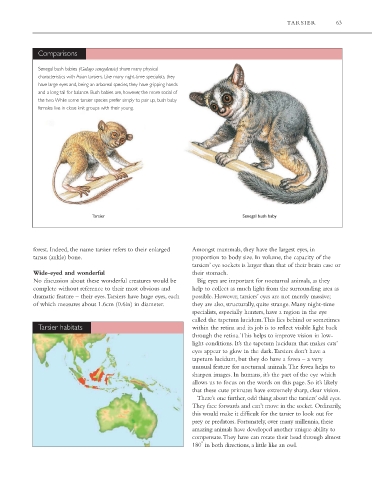
              Senegal bush babies (Galago senegalensis) share many physical
              characteristics with Asian tarsiers. Like many night-time specialists, they
              have large eyes and, being an arboreal species, they have gripping hands
              and a long tail for balance. Bush babies are, however, the more social of
              the two.While some tarsier species prefer simply to pair up, bush baby
              females live in close knit groups with their young.


                                 Tarsier                                             Senegal bush baby


             forest. Indeed, the name tarsier refers to their enlarged  Amongst mammals, they have the largest eyes, in
             tarsus (ankle) bone.                                   proportion to body size. In volume, the capacity of the
                                                                    tarsiers’ eye sockets is larger than that of their brain case or
             Wide-eyed and wonderful                                their stomach.
             No discussion about these wonderful creatures would be  Big eyes are important for nocturnal animals, as they
             complete without reference to their most obvious and   help to collect as much light from the surrounding area as
             dramatic feature – their eyes.Tarsiers have huge eyes, each  possible. However, tarsiers’ eyes are not merely massive;
             of which measures about 1.6cm (0.6in) in diameter.     they are also, structurally, quite strange. Many night-time
                                                                    specialists, especially hunters, have a region in the eye
                                                                    called the tapetum lucidum.This lies behind or sometimes
              Tarsier habitats                                      within the retina and its job is to reflect visible light back
                                                                    through the retina.This helps to improve vision in low-
                                                                    light conditions. It’s the tapetum lucidum that makes cats’
                                                                    eyes appear to glow in the dark.Tarsiers don’t have a
                                                                    tapetum lucidum, but they do have a fovea – a very
                                                                    unusual feature for nocturnal animals.The fovea helps to
                                                                    sharpen images. In humans, it’s the part of the eye which
                                                                    allows us to focus on the words on this page. So it’s likely
                                                                    that these cute primates have extremely sharp, clear vision.
                                                                     There’s one further, odd thing about the tarsiers’ odd eyes.
                                                                    They face forwards and can’t move in the socket. Ordinarily,
                                                                    this would make it difficult for the tarsier to look out for
                                                                    prey or predators. Fortunately, over many millennia, these
                                                                    amazing animals have developed another unique ability to
                                                                    compensate.They have can rotate their head through almost
                                                                       o
                                                                    180 in both directions, a little like an owl.


                                             (c) 2011 Marshall Cavendish. All Rights Reserved.

