


Page 69 - Atlas Of The World's Strangest Animals
P. 69
DUCK-BILLED PLATYPUS               69


              Comparisons

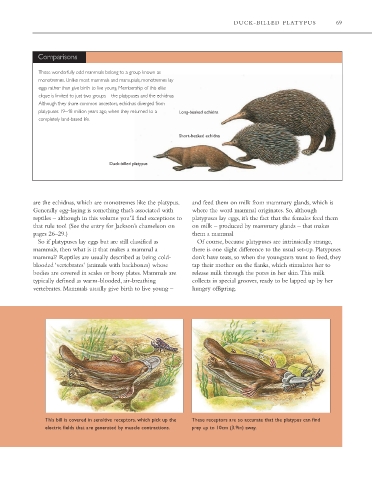
              These wonderfully odd mammals belong to a group known as
              monotremes. Unlike most mammals and marsupials, monotremes lay
              eggs rather than give birth to live young. Membership of this elite
              clique is limited to just two groups –the platypuses and the echidnas.
              Although they share common ancestors, echidnas diverged from
              platypuses 19–48 million years ago, when they returned to a  Long-beaked echidna
              completely land-based life.


                                                               Short-beaked echidna


                                       Duck-billed platypus


             are the echidnas, which are monotremes like the platypus.  and feed them on milk from mammary glands, which is
             Generally egg-laying is something that’s associated with  where the word mammal originates. So, although
             reptiles – although in this volume you’ll find exceptions to  platypuses lay eggs, it’s the fact that the females feed them
             that rule too! (See the entry for Jackson’s chameleon on  on milk – produced by mammary glands – that makes
             pages 26–29.)                                          them a mammal
              So if platypuses lay eggs but are still classified as  Of course, because platypuses are intrinsically strange,
             mammals, then what is it that makes a mammal a         there is one slight difference to the usual set-up. Platypuses
             mammal? Reptiles are usually described as being cold-  don’t have teats, so when the youngsters want to feed, they
             blooded ‘vertebrates’ (animals with backbones) whose   tap their mother on the flanks, which stimulates her to
             bodies are covered in scales or bony plates. Mammals are  release milk through the pores in her skin.This milk
             typically defined as warm-blooded, air-breathing       collects in special grooves, ready to be lapped up by her
             vertebrates. Mammals usually give birth to live young –  hungry offspring.


                 This bill is covered in sensitive receptors,which pick up the  These receptors are so accurate that the platypus can find
                 electric fields that are generated by muscle contractions.  prey up to 10cm (3.9in) away.


                                             (c) 2011 Marshall Cavendish. All Rights Reserved.

