


Page 68 - Atlas Of The World's Strangest Animals
P. 68
68       ATLAS  OF THE WORLD’S  STRANGEST ANIMALS


                                                                  the flesh, however, it becomes clear just how strange they
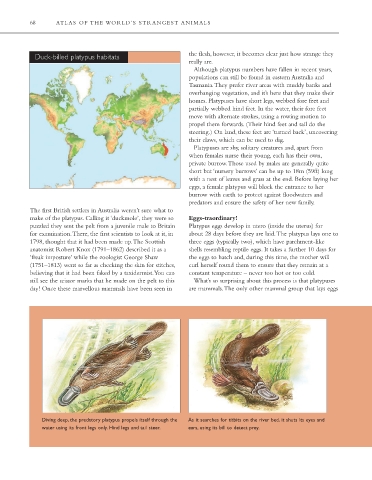
             Duck-billed platypus habitats
                                                                  really are.
                                                                    Although platypus numbers have fallen in recent years,
                                                                  populations can still be found in eastern Australia and
                                                                  Tasmania.They prefer river areas with muddy banks and
                                                                  overhanging vegetation, and it’s here that they make their
                                                                  homes. Platypuses have short legs, webbed fore feet and
                                                                  partially webbed hind feet. In the water, their fore feet
                                                                  move with alternate strokes, using a rowing motion to
                                                                  propel them forwards. (Their hind feet and tail do the
                                                                  steering.) On land, these feet are ‘turned back’, uncovering
                                                                  their claws, which can be used to dig.
                                                                    Platypuses are shy, solitary creatures and, apart from
                                                                  when females nurse their young, each has their own,
                                                                  private burrow.Those used by males are generally quite
                                                                  short but ‘nursery burrows’ can be up to 18m (59ft) long
                                                                  with a nest of leaves and grass at the end. Before laying her
                                                                  eggs, a female platypus will block the entrance to her
                                                                  burrow with earth to protect against floodwaters and
                                                                  predators and ensure the safety of her new family.
           The first British settlers in Australia weren’t sure what to
           make of the platypus. Calling it ‘duckmole’, they were so  Eggs-traordinary!
           puzzled they sent the pelt from a juvenile male to Britain  Platypus eggs develop in utero (inside the uterus) for
           for examination.There, the first scientists to look at it, in  about 28 days before they are laid.The platypus lays one to
           1798, thought that it had been made up.The Scottish    three eggs (typically two), which have parchment-like
           anatomist Robert Knox (1791–1862) described it as a    shells resembling reptile eggs. It takes a further 10 days for
           ‘freak imposture’ while the zoologist George Shaw      the eggs to hatch and, during this time, the mother will
           (1751–1813) went so far as checking the skin for stitches,  curl herself round them to ensure that they remain at a
           believing that it had been faked by a taxidermist.You can  constant temperature – never too hot or too cold.
           still see the scissor marks that he made on the pelt to this  What’s so surprising about this process is that platypuses
           day! Once these marvellous mammals have been seen in   are mammals.The only other mammal group that lays eggs


                Diving deep, the predatory platypus propels itself through the  As it searches for titbits on the river bed, it shuts its eyes and
                water using its front legs only. Hind legs and tail steer.  ears, using its bill to detect prey.


                                             (c) 2011 Marshall Cavendish. All Rights Reserved.

