


Page 72 - Atlas Of The World's Strangest Animals
P. 72
72       ATLAS  OF THE WORLD’S  STRANGEST ANIMALS


           Being big doesn’t necessarily mean that you can’t get
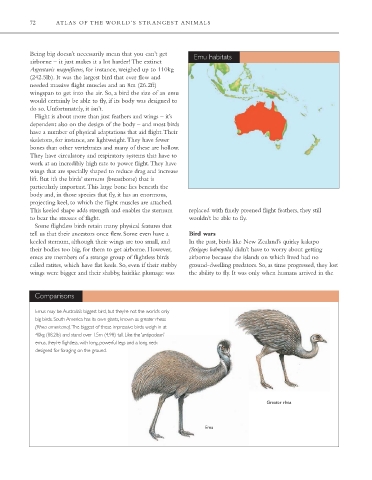
                                                                    Emu habitats
           airborne – it just makes it a lot harder! The extinct
           Argentavis magnificens, for instance, weighed up to 110kg
           (242.5lb). It was the largest bird that ever flew and
           needed massive flight muscles and an 8m (26.2ft)
           wingspan to get into the air. So, a bird the size of an emu
           would certainly be able to fly, if its body was designed to
           do so. Unfortunately, it isn’t.
             Flight is about more than just feathers and wings – it’s
           dependent also on the design of the body – and most birds
           have a number of physical adaptations that aid flight.Their
           skeletons, for instance, are lightweight.They have fewer
           bones than other vertebrates and many of these are hollow.
           They have circulatory and respiratory systems that have to
           work at an incredibly high rate to power flight.They have
           wings that are specially shaped to reduce drag and increase
           lift. But it’s the birds’ sternum (breastbone) that is
           particularly important.This large bone lies beneath the
           body and, in those species that fly, it has an enormous,
           projecting keel, to which the flight muscles are attached.
           This keeled shape adds strength and enables the sternum  replaced with finely preened flight feathers, they still
           to bear the stresses of flight.                        wouldn’t be able to fly.
             Some flightless birds retain many physical features that
           tell us that their ancestors once flew. Some even have a  Bird wars
           keeled sternum, although their wings are too small, and  In the past, birds like New Zealand’s quirky kakapo
           their bodies too big, for them to get airborne. However,  (Strigops habroptila) didn’t have to worry about getting
           emus are members of a strange group of flightless birds  airborne because the islands on which lived had no
           called ratites, which have flat keels. So, even if their stubby  ground-dwelling predators. So, as time progressed, they lost
           wings were bigger and their shabby, hairlike plumage was  the ability to fly. It was only when humans arrived in the


             Comparisons


             Emus may be Australia’s biggest bird, but they’re not the world’s only
             big birds. South America has its own giants, known as greater rheas
             (Rhea americana).The biggest of these impressive birds weigh in at
             40kg (88.2lb) and stand over 1.5m (4.9ft) tall. Like the ‘antipodean’
             emus, they’re flightless, with long, powerful legs and a long neck
             designed for foraging on the ground.


                                                                                             Greater rhea


                                                                        Emu


                                             (c) 2011 Marshall Cavendish. All Rights Reserved.

