


Page 128 - (DK Eyewitness) Travel Guide - Greek Islands
P. 128
3 \-=
          MASTIC VILLAGES


          ΜΑΣΤΙΧΟΧΏΡΙΑ

        ⌂ 28 km (17 miles) SW of Híos town    @ Mestá
      EXPERIENCE  The Northeast Aegean Islands  resin, which formed the basis of paints, cosmetics and medicine.
        The mastic villages, 20 remarkable settlements situated in southern
        Híos, were founded by Genovese occupiers in the 14th and 15th
        centuries to protect the immensely lucrative production of mastic


        Situated well inland to protect against pirate
        attack, the mastic villages are almost fortress-
        like in their unique defensive features, made
        all the more necessary by Híos’s proximity to
        Turkey. Key defensive features were perim eter
        walls with guarded fortification towers, flat
        roofs to facilitate escape and deliberately
        confusing streets designed to an intricate grid.
        Though they were the only villages to be
        spared in the 1822 massacre (p126), most have
        had their architecture compromised by ill-
                  advised modernization and
                    earthquake damage. The
                      most photogenic of
                       the villages is Pyrgi,
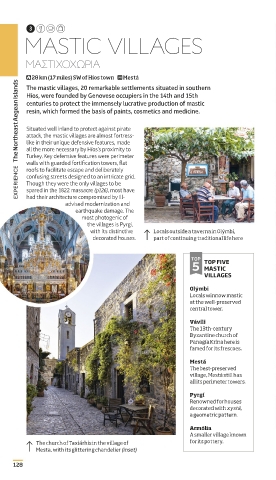
                        with its distinctive   Locals outside a taverna in Olýmbi,
                         decorated houses.   part of continuing traditional life here

                                                  TOP  TOP FIVE
                                                  5  MASTIC
                                                     VILLAGES

                                                  Olýmbi
                                                  Locals winnow mastic
                                                  at the well-preserved
                                                  central tower.
                                                  Vávili
                                                  The 13th-century
                                                  Byzantine church of
                                                  Panagía Krína here is
                                                  famed for its frescoes.
                                                  Mestá
                                                  The best-preserved
                                                  village, Mestá still has
                                                  all its perimeter towers.
                                                  Pyrgí
                                                  Renowned for houses
                                                  decorated with xystá,
                                                  a geometric pattern.
                                                  Armólia
                                                  A smaller village known
          The church of Taxiárhis in the village of   for its pottery.
          Mesta, with its glittering chandelier (inset)
    128


   128-129_EW_Greek_Islands.indd   128                       28/11/2018   09:52


 EW Must-see template v2 – 12th July 2018
 Fonts: Aptifer Sans LT Pro, Posterama Text, Soho Gothic
 Pro, Soho Pro, ITC Caslon 224

