


Page 133 - (DK Eyewitness) Travel Guide - Greek Islands
P. 133
OLIVE GROWING IN GREECE
         A symbol of peace since ancient times, the first
         olive tree was said to have been planted by the
         goddess Athena on the Acropolis in Athens.

         The Cretan Minoans are thought to have been the first
         people to have cultivated the olive tree, in around 3800
         BC. The magnificent olive groves of modern Greece date
         back to 700 BC, when olive oil became a valuable export
         commodity. The 11 million or so olive trees on Lésvos   TYPES OF OLIVES
         are reputed to be the most productive oil-bearing trees   From the mild fruits of
         in the Greek islands; Crete produces more and better-  the Ionians to the small,
         quality oil, but no other island is so dominated by olive   rich olives of Crete, the
         monoculture. The best olives on Lésvos come from the   Greek islands are a
         hillside plantations between Plomári and Agiásos,   paradise for olive lovers.
         founded in the 18th century by local farmers The fruits
         can be cured for eating throughout the year, or pressed   Elítses are small, sweetly
         to provide a nutritious and versatile oil. Further   flavoured olives from the
         crushing yields oil for soap and lanterns, and the pulp is   island of Crete.
         used as fertilizer.                  Tsakistés are picked
                                              young and lightly cracked
                                              before curing in brine.
                                              Throúmpes are a true
                                              taste of the countryside,
                                              very good as a mezedes
                                              with olive-oil bread.
                                              Kalamáta, the most
                                              famous Greek olive, is
                                              glossy-black, almond-
                                              shaped and cured in
                                              red-wine vinegar.
                                              Thásos olives are salt-
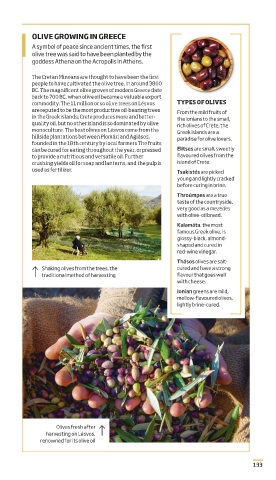
            Shaking olives from the trees, the   cured and have a strong
            traditional method of harvesting   flavour that goes well
                                              with cheese.
                                              Ionian greens are mild,
                                              mellow-flavoured olives,
                                              lightly brine-cured.


               Olives fresh after
             harvesting on Lésvos,
           renowned for its olive oil


                                                                  133


   132-133_EW_Greek_Islands.indd   133                       28/11/2018   13:12

