


Page 219 - (DK Eyewitness) Travel Guide - Greek Islands
P. 219
spectacular, divided into the
                           fortified kástro quarter and   POLITICAL EXILES
          Did You Know?    main village surrounding it.   ON FOLÉGANDROS
                                                 AND AMORGÓS
                           The kástro, built in the 13th
                           century by Marco Sanudo,
          Kímisi tis Theotókou                   These remote islands
         was built using stones   Duke of Náxos, is reached   have long been used
           from the ancient   through an arcade. Within its   for political exile. The
          temple of Artemis.  maze of crazy-paved alleys   Romans first selected
                           full of geraniums are two-  isolated Folégandros
                           storey cube houses with   for this purpose. The
                           brightly painted wooden   most famous exile on
                           balconies and white steps up.   Amorgós (p220) was
       walk to the east is the busy   It is rimmed with tall stone   George Mylonas,
       resort of Platýs Gialós, with    houses backing onto the sea,   Minister of Education in
       its long sandy beach. This is   forming a strong hold along   the government before
       also connected by bus to   the ridge of the cliff. Village   1967. He escaped from
       Apollonía and Kamáres.  life here centres on four   the island by speedboat
                           squares with craft shops, lively   in 1969, telling the story
       Museum of Popular Arts   tavernas and bars. The stair-  in his memoir Escape
       and Folklore        path from the central bus stop   from Amorgós.
       "   ⌂ Platía Iróön   § 22840   leads to the church of Kímisi
       33730   # Jun–Sep: 7am–   tis Theotókou (Assumption
       11pm daily          of the Virgin Mary), which   is a string of farming hamlets
                           dominates the village. It was   on either side of the road,
       Archaeological Museum  built after a silver icon was   surrounded by terraced fields.
       ⌂ Kástro   § 22840 31022     miraculously saved by a villager  There are wonderful sunset
       # Apr–Oct: 8am–3pm Tue–  from medi eval pirates who   views here and on a clear day
       Sun (limited in winter)     drowned in a storm.   you may be able to see Crete
       ¢ Main public hols    Ferries dock at Karavostási   in the distance.
                           on the east coast, a tiny     The excellent Ecomuseum
                           harbour with a tree-fringed   presents the way of life in a
       7                   pebble beach, restaurants,   rural homestead in days gone
                           hotels and rooms. There is a
                                               by. Displays include farming
       Folégandros         bus to Hóra, and Livádi beach   implements, grape and oil
       Φολέγανδρος         is a short walk from the port.   presses, a threshing floor and
                           In season there are excursions   reconstructions of traditional
       g @ Karavostási   n Hóra;   available to the western   peasant life. On 27 July a
       www.folegandros.gr
                           beaches at Angáli, Ágios   major local festival is held
       Bleak and arid, Folégandros is   Nikólaos and Latináki, as well   here for Ágios Pandelímon.
       one of the smallest inhabited   as to the island’s most popular  From Áno Meriá steep paths
       islands in the Cyclades and,   sight, the Chrysospiliá or   weave down to the remote
       with its towns perched on   Golden Cave. Named after the   beaches at Ágios Geórgios
       vertiginous cliffs, aptly takes   golden shade of its stalactites   bay and Livadáki, which is
       its name from the Phoenician   and stalagmites, the grotto   wildly beautiful.
       for “rocky”. This remote island   lies just above sea level in
       was often used as a place of   the northeasterly cliffs.  Ecomuseum
       exile, and suffered from the     Áno Meriá, 5 km (3 miles) to   ⌂ Áno Meriá   § 22860 41370
       threat of pirate attack.  the west of Folégandros town,   # Jun–Sep: 5–8pm daily
         Popular with photographers
       and artists, Folégandros can
       be busy in peak season. It’s
       also a good place for walkers,
       offering a wild beauty and
       unspoiled beaches.
         Folégandros town, or Hóra,
       perched 300 m (985 ft) above
       the sea to avoid pirates, is


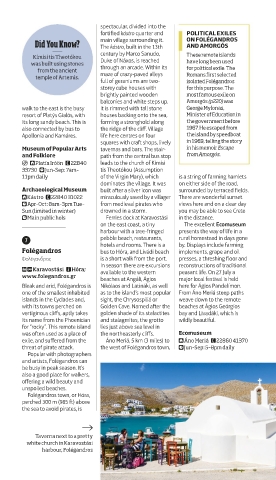
          Taverna next to a pretty
        white church in Karavostási
            harbour, Folégandros


   218-219_EW_Greek_Islands.indd   219                       04/01/2019   10:45

