


Page 216 - (DK Eyewitness) Travel Guide - Greek Islands
P. 216
EXPERIENCE MORE


        3                   the island, including a
                            collection of Minoan artifacts
        Kéa (Tziá)          from Agía Iríni. The legendary   Did You Know?
        Κέα                 6th-century BC Lion of Kéa is   tells that jealous gods
                                                   The Lion of Kéa myth
                            carved into the rock 400 m
      EXPERIENCE  The Cyclades  first inhabited around 3000   reached through a white   4  beautiful nymphs.
        4 @ Korissía   n www.kea.gr
                            (1,300 ft) north of the town.
                                                   sent a lion to destroy
                              The kástro quarter is
        Kéa, also known as Tziá, was
                                                    the island and its
        BC and later settled by
                            archway, and stands on the
                            site of the acropolis. Built by
        Phoenicians and Cretans.
        Moun tainous with fertile
                            the Venetians in 1210 using
                            stones from the ancient walls
        valleys, Kéa has been known
                            and Temple of Apollo, it has
        since ancient times for its
        wine, honey, oak trees and
                              Just north of the port of
        almonds. Today, the island
                                                Κύθνος
                            Korissía is the archaeological
        is favoured by Athenians   panoramic views.   Kýthnos (Thermiá)
                                                g @ Mérihas   n www.
        escaping from the city for    site of Agía Iríni. The Bronze
        a weekend break.    Age settle ment was destroyed   kythnos.gr
          Kéa’s port of Korissía can be   by an earthquake in 1450 BC,   Barren Kýthnos attracts more
        packed with Greek families on   and was excavated from 1960   Greek visitors than foreign
        holiday. From Korissía, catch    to 1968. First occupied at the   tourists, although it is a
        a bus or ferry to the capital,   end of the Neolithic period,   popular anchorage for flotilla
        Ioulída, perched on a hillside    the town was fortified twice     holidays. Known locally as
        5 km (3 miles) above Korissía.   in the Bronze Age. There are   Thermiá because of its hot
        A maze of winding alleyways,   remains of the great wall with   springs, the island attracts
        Ioulída was founded in Classical  a gate and a tower. The most   visitors to the thermal spa at
        times. Its centre piece is a   spectacular monument on Kéa   Loutrá. Its dramatic, rugged
        spectacular 1902 Neo-Classical   is the Hellenistic tower at Moní   interior, which has excellent
        town hall with statues of Apollo  Agías Marínas, 5 km (3 miles)   walking trails, is fringed by
        and Athena. In the entrance     south west of Ioulída.  some good beaches.
        is a sculpture of a woman and             The local clay, tradition ally
        child found at Karthaia. Inside   Archaeological Museum  used for pottery and ceramics,
        a fine Neo-Classical house,    "   § 22880 22079   # Apr–  is also used to make the red
        the Archaeological Museum   Oct: 8am–3:30pm Tue–Sun     roofi ng tiles that cha racterize
        displays finds from around   ¢ Main public hols  all the island’s villages.


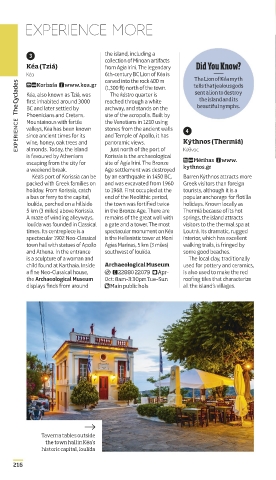
            Taverna tables outside
             the town hall in Kéa’s
            historic capital, Ioulída

    216


   216-217_EW_Greek_Islands.indd   216                       28/11/2018   09:55


 EW Must-see / Catalogue template v1.1 – 18th May 2018
 Fonts: Aptifer Sans LT Pro, Posterama Text, Soho Gothic
 Pro, Soho Pro, ITC Caslon 224

